Get Full Government Meeting Transcripts, Videos, & Alerts Forever!
Get email alerts on the Education Omnibus Bill Sf1740 topic
No spam. Unsubscribe anytime.
Senate passes sweeping education package after hours of amendment votes on discipline, standards and schools' flexibility
Summary
The Minnesota Senate passed Senate File 1740, an omnibus education policy bill, after lengthy debate and votes on multiple amendments that addressed student safety, seclusion, charter oversight, school calendars and other school policies.
The Minnesota Senate passed Senate File 1740, a sweeping education policy bill, after extended floor debate and more than a dozen substantive amendments on topics that included special‑education seclusion rules, charter-school accountability, school start dates, substitute teacher pay, student safety, sex‑education and gender‑identity provisions, and school data and transparency.
Sponsor remarks on the floor framed the bill as the product of months of bipartisan work in committee; the bill’s backers said it would strengthen accountability and student supports across the state. Opponents and some local-school officials urged caution and sought changes on several fronts.
Key floor actions and debates included: - Seclusion and student safety: Senators debated an amendment (A32) that would allow narrowly defined, parent‑ and IEP‑approved use of seclusion spaces for some students up through grade 6, when teams and parents agreed it was necessary for safety. Supporters — including several classroom teachers and parents — described cases where restricted seclusion had helped manage violent outbursts and preserve access to school for some students. Opponents warned of potential trauma and urged strict limits and oversight; another amendment added technical clarifications and parental-consent requirements.
- Charter schooling and oversight: The bill contains provisions described on the floor as charter-school regulatory reforms. Sponsors said much of the charter-related language was added in response to an investigative series and stakeholder input.
- School calendar flexibility for 2026–28: The body debated an amendment (A64) to give districts a two‑year discretionary window to begin school before Labor Day for the 2026–27 and 2027–28 school years; supporters cited construction scheduling and diverse community calendars, while opponents cited possible economic harm to resort and tourism communities. That amendment was defeated on final vote.
- Substitute-teacher program: The Senate adopted an amendment (A71) to make the short‑call substitute program broadly available statewide while allowing pay flexibility for smaller districts, a change supporters said would expand access in greater Minnesota.
- School surveys and library materials: The Senate rejected multiple amendments that would have changed requirements for the statewide Minnesota Student Survey, student‑survey parental consent, and the adoption of social studies and ethnic studies standards. An amendment to require parental opt‑in for the statewide student survey did not pass; an amendment to require filtering of obscene material in school libraries and media centers was also rejected.
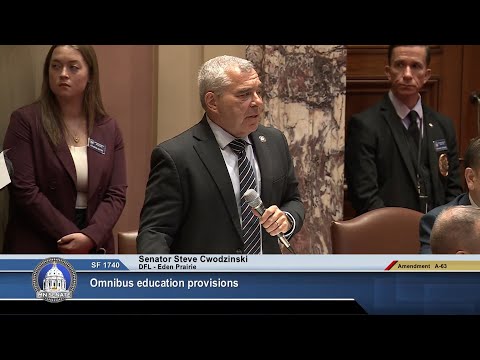
- Athletics insurance: The chamber adopted an amendment (A63) requiring the Minnesota State High School League to maintain a catastrophic injury insurance policy with at least $5 million per catastrophic injury and authorizing the league’s foundation to make payments to a small number of past injured athletes; sponsors said the change came after family testimony about inadequate coverage.
- Curriculum and graduation requirements: The Senate considered but ultimately rejected an amendment that would have removed algebra II as a statewide graduation requirement; the body adopted an amendment to ensure algebra II remained available as an option in schools.
Final passage came after recorded votes on several amendments and debate over equity, local control and student safety. The secretary announced final passage of SF 1740 as amended by roll call, with 39 ayes and 26 nays.