Get AI Briefings, Transcripts & Alerts on Local & National Government Meetings — Forever.
Petersburg leaders hear FY‑26 schools budget; council signals intent to fully fund $12.97 million transfer
Loading...
Summary
Petersburg City Public Schools presented a proposed FY‑26 budget that relies on increased state funding and requests a roughly $12.97 million city transfer; council members asked detailed questions about health insurance, chronic absenteeism, transportation and teacher recruitment and signaled intent to fund the requested transfer.
PETERSBURG, Va. — Petersburg City Public Schools on Monday presented a proposed fiscal 2026 budget that school officials said relies on a larger state share and requests a city transfer of roughly $12.97 million for operating needs while funding a $2.4 million capital/technology plan and new staff positions.
The presentation, led by budget consultant John Wallingford and Superintendent Brown, outlined revenue gains from the state and a proposed mix of personnel and nonpersonnel initiatives. John Wallingford, who described himself as the person who “substantially built this this budget that I'm about to present to you,” said the conference budget received from the Virginia Department of Education increases the local required share and enables the division to fund a capital improvement/technology plan.
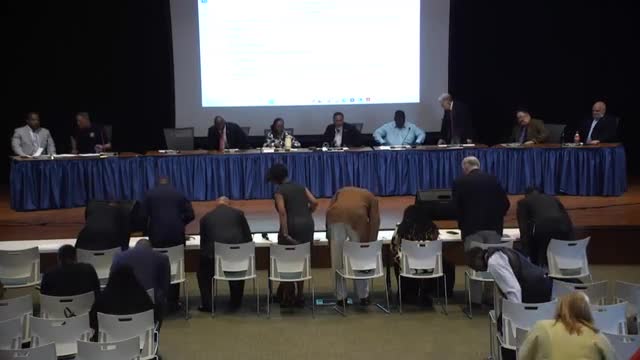
The school team asked the Petersburg City Council to adopt the all‑funds budget as presented and to provide the calculated local transfer. Mayor Perham and other council members said the council “plan[s] to fully fund the schools” and indicated support for the requested transfer during the meeting, though no formal vote on the transfer was recorded at the joint session.
Why it matters: The budget presentation affects instructional staffing, classroom supports and capital needs across the city’s schools. School leaders emphasized staffing, licensure and attendance work as priorities tied to student outcomes and to the district’s ability to use the additional state and local dollars.
What the proposal includes - Revenues and totals: Wallingford said state funding year‑over‑year increased by about $5.2 million and identified a conference figure for the city transfer near $12.97 million. The division presented an all‑funds total just under $90 million (general fund, food service and grants combined). Food service was shown at about $3.3 million; the grants fund was estimated near $15 million. - Technical adjustments: the budget includes a 3% salary increase (as provided by the General Assembly), an 8% projected increase in health‑insurance costs, an additional $48,000 for liability insurance and about $300,000 for higher fuel and utility costs. Non‑salary (“flex”) budgets for schools and departments were increased on average by about 2%. - One‑time and ongoing initiatives: the budget documents list a $2.4 million CIP/TIP (capital and technology) set‑aside, additions of multiple full‑time positions across the division (two parent liaisons, teacher induction/HR capacity, additions to specialty programs such as Appomattox Regional Governor’s School and CodeRVA), and an ask to fund an assistant athletic director position. - Instructional share: Wallingford presented categorical totals showing instruction slightly above VDOE’s 65% benchmark, with instruction at roughly $46 million of the general fund.
Discussion highlights and staff responses - Health insurance and consolidation: Mayor Perham pressed the schools on the projected 8% increase in health‑insurance costs and asked whether the division could access the city insurance plan to reduce rates. Superintendent Brown said the division was already in the process of adopting a new provider and collecting staff feedback; she and Wallingford said they would continue to explore options with the city’s human resources staff. As Mayor Perham put it, “I don't want them to lose a 3% raise and a 8%, health care cost increase.”
- Chronic absenteeism and attendance strategy: Superintendent Brown said the division has targeted chronic absenteeism, noting that “Petersburg has a significant number of students who are chronically absent every single day.” She described steps begun this year: expanded use of PowerSchool data and an attendance dashboard so principals and teachers can track absences, a school‑level attendance plan that assigns roles to the division, principals and teachers, earlier intervention before truancy thresholds, a partnership with Virginia State University funded by a Cameron Foundation grant, and two parent‑liaison positions requested in the FY‑26 budget to place engagement staff in schools rather than only at central office.
- Teacher recruitment and licensure: Council members and school leaders discussed recruiting and retaining certified teachers. Superintendent Brown said about 25% of elementary teachers were fully licensed and noted several strategies: a proposed $7,500 stipend for the first 50 certified teachers (if the board and funding are approved), a comp‑and‑class study to rebenchmark local pay, support and reimbursement for licensure coursework and practice exams, partnerships with Virginia State University and Richard Bland, and a requested HR position focused on teacher induction and licensure tracking. On the stipend and recruitment approach, school leaders framed the package as one piece of a broader retention strategy that includes professional development and changes to the calendar to provide more focused teacher learning days.
- Transportation and bus service: Council members and the superintendent said the district faces a nationwide driver shortage. Council members reported students waiting as long as an hour and a half for activity or specialty buses that serve programs such as Appomattox and CodeRVA. The division said it would investigate activity‑bus schedules, coordinate with athletics and tutoring buses where possible, and work with coaches and principals to align practice and bus schedules.
- Dual enrollment, career pathways and internships: The district described ongoing partnerships with Richard Bland College and others to expand dual‑enrollment and career pathways. Paul Brown, the district’s chief academic officer, said “There's definitely funding. We use funding from the state, as well as from our, some federal funds,” and stressed the need to prepare students earlier so more can access dual‑enrollment opportunities. Council members also urged the schools to prioritize Petersburg students for local employer partnerships tied to the upcoming casino project and to expand internship hours and summer programming.
- Fund accounting and fund balance: Wallingford recommended maintaining a fund balance target (he suggested $3 million as an example) to manage forecasting fluctuations. Council members asked how a fund balance would work when local policy returns unspent funds to the city; Wallingford said maintaining some fund balance eases financial management but acknowledged legal and policy constraints under the Code of Virginia and local practices.
Questions left for follow‑up Council members asked for additional details on the school insurance contract and timeline for any consolidation with city insurance, a review of activity‑bus schedules and driver shortages, specific plans and estimated costs to upgrade aging facilities (several council members asked about neighborhood schools such as Blandford), and further detail on how the division will convert planning and revenue gains into year‑over‑year implementation. School leaders said they would continue to refine the FY‑26 budget and return to council with formal adoption as a separate step; the schools’ presented timeline listed the city council adoption as the remaining step after the joint meeting.
Ending The joint meeting closed with council members and school leaders saying they would continue the budget work together; the city council indicated it intends to fully fund the proposed transfer as presented at the meeting but did not take a formal recorded vote during the joint session. The school division will provide the next materials and seek formal adoption during the council’s budget process.