Get Full Government Meeting Transcripts, Videos, & Alerts Forever!
Get email alerts on the District Scorecard topic
No spam. Unsubscribe anytime.
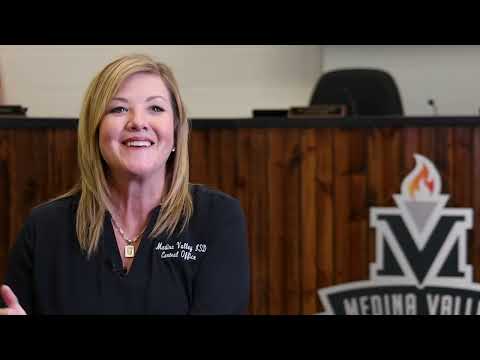
Medina Valley ISD staff describe district scorecard to track four priorities
Summary
A Medina Valley ISD staff member outlined a district scorecard designed to measure progress on four priorities — students, staff, community involvement and finances/operations — and described curriculum alignment, baseline measures and ongoing adjustments to implementation.
A staff member with Medina Valley ISD described a new district scorecard as a tool to measure whether the district is meeting its stated priorities and to keep stakeholders aligned. "Scorecard is a way for us to determine to measure are we achieving the goals or priorities that we want to achieve," the staff member said.
The staff member said the scorecard centers on four priorities: students; staff recruitment and retention; community involvement; and finances and operations. "So the first thing you do is, alright, really really look at what is it that you want to achieve as a district. So we came up with four, which is students...Second is our staff...we want our community involved...and then our fourth one is our finances and our operations," the staff member said.
The presentation emphasized local development and stakeholder input. The speaker said the district engaged several stakeholders "from our school board to our administrators and and staff members and even some of our parents and community members" in creating the scorecard.
As one concrete step, the staff member described creating a district curriculum by convening teachers to identify essential knowledge and skills at each grade level, then aligning that curriculum "first horizontally, and then this year we've started working on vertical alignment" so students are prepared year to year.
The staff member also said the district is establishing baselines to measure year-over-year improvement: "Being a numbers person, it's also nice to say that we've improved this much this year. And so some of the work we're doing this year is creating some baselines so that we know next year, here's some areas that we need to improve in, and here's how we're gonna know if we did better." Implementation and monitoring will prompt adjustments, the speaker said: "This is a big undertaking...as you implement and as you really, begin to evaluate and monitor, you see adjustments that have to be made...and we will continue to do that and that will be a continuous process."
The staff member contrasted the locally developed scorecard with the state accountability system, saying some people question whether the state system accurately measures district success. "You also have the state accountability system, which there are a lot of people out there that have questions about that, whether or not that's truly a good measure...So by developing something like this that's local, that's developed by the people in the district, for the people in the district, I just feel like that's something that's much more, accountable, something that is a much better measure that shows us whether or not we're achieving the things we want to achieve," the speaker said.
No formal motions, votes or deadlines were described in the remarks. The presentation framed the scorecard as an ongoing, adjustable management tool rather than a final policy change.