Get Full Government Meeting Transcripts, Videos, & Alerts Forever!
Get email alerts on the District Budget Revenue Assumptions topic
No spam. Unsubscribe anytime.
Kyrene presents fiscal 2026 revenue assumptions for special revenue, debt and internal service funds
Summary
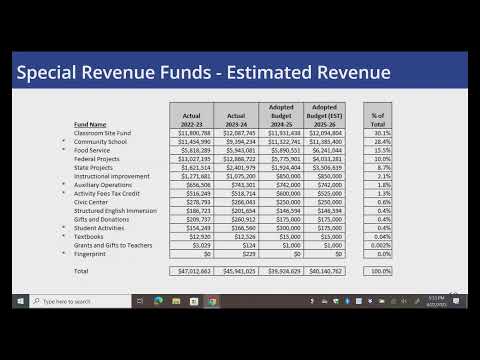
At a study session, CFO Chris Herman laid out fiscal 2026 revenue projections: about $40 million in special revenue funds, $26.2 million in debt service revenue and roughly $13.6 million in employee-benefit trust revenue, while flagging declines in federal reimbursements and a structural shortfall in athletics.
CFO Chris Herman presented the Kyrene Elementary District’s preliminary revenue assumptions for fiscal year 2026 during a study session on Monday, outlining projections for special revenue funds, the debt service fund and internal service funds.
Herman said the district expects about $40 million in special revenue funds, roughly $26.2 million in debt service revenue and about $13.6 million in projected contributions to the Kyrene Employee Benefits Trust (KEBT), which he said accounts for roughly 85% of internal service fund revenue.
The presentation focused on how those totals were derived and what they represent for the district’s budget. "We always start by showing what our budget annual report is," Herman said, noting the materials are intended to explain methodology and assumptions to the board and the public.
The classroom site fund (Prop 301) is the largest special revenue fund. Herman said the state per-pupil allocation for Prop 301 is projected at $842 per pupil for the coming year, up from $792, producing a Kyrene allocation of just over $12,100,000. He cited ARS 15-977 when describing Prop 301 and said state legislative changes in 2021 expanded allowable uses to include some student-support functions (function 2,100) in addition to classroom instructional costs (function 1,000).
Community education programs — including kids club, preschool, before- and after-school programs and summer enrichment — make up the next-largest special revenue category. Herman said Kyrene operates one of the state’s largest community education programs and that, before the COVID-19 pandemic, those programs generated $2.5 million to $3 million in profit annually that was reinvested in district operations. He added that post-COVID profitability has been lower because of higher personnel costs and lower enrollment, though the district expects 2025–26 results to be sustainable and closer to recent years’ figures.
Federal projects (Title funds, IDEA Part B, E-rate and previously ESSER grants) account for a substantial portion of special revenue but are estimated to decline year to year. Herman said the total federal projects category is down about $1.7 million compared with the prior year, largely because last year’s budget included roughly $1.1 million in E-rate reimbursements that are not expected in 2025–26 and about $400,000 in uncertainty around IDEA allocations. He noted that ESSER (Elementary and Secondary School Emergency Relief) grants from federal pandemic stimulus bills have expired.
Athletics, recorded in the auxiliary operations fund, is not self-sustaining, Herman said. He gave an estimated athletics revenue of about $623,000 for next year against estimated expenditures of about $900,000, producing an expected shortfall near $250,000 that the district covers from maintenance and operations or other operating dollars. Member Davis questioned whether sports were self-funding; Herman replied that participation fees generate revenue but "that's not enough to cover the cost to run those same activities."
State grants classified as "state projects" include the Safe School grant, the Safe School mini grant and First Things First. Herman said the Safe School grant cycle funds counselors, social workers and school resource officers and that for the coming year Kyrene would receive funding to cover positions described as nine full-time counselors and six SROs at the middle schools under that grant cycle. Herman also noted the Safe School mini grant funds full-time counselors at the remaining school sites so that all 25 Kyrene sites are covered. First Things First was described as a smaller, roughly $56,000 award supporting early childhood programs and families.
Food service revenue is projected slightly lower than last year because Kyrene outsources cafeteria operations to a third-party vendor and budgeted amounts vary with meals served. Herman said structured English immersion is a competitive state grant; the award amount for 2025–26 is not yet known and will be adjusted if the grant is awarded in June or July.
On internal service funds, Herman said KEBT revenue is estimated at about $13.6 million, with roughly 80% paid by the district and 20% by employees. He said recent plan redesigns and lower medical costs have led to improved trust fund stability. He also listed other internal service items — print shop revenue, a workers' compensation self-insurance estimate of about $605,000 and shared legal costs billed through an intergovernmental agreement with Tempe Union.
Board members asked clarification questions at the end of the presentation. Member Davis asked about where athletic-related tax-credit contributions are recorded; Herman said athletic tax credits are recorded in auxiliary operations while nonathletic tax credits go to the activities fees/tax credit line. The board recessed to convene the regular meeting at 6 p.m.; no formal action or votes were taken on the figures presented during the study session.