Get Full Government Meeting Transcripts, Videos, & Alerts Forever!
Get email alerts on the Hr Budget Labor Negotiations topic
No spam. Unsubscribe anytime.
City staff outline HR budget pressures and multiyear labor bargaining schedule ahead of mayor’s budget
Summary
Human Resources and City Budget Office staff briefed the Labor and Workforce Development Committee on April 24 about HR budget structure, health fund accounting, a backlog of payroll system changes and a multi-year labor negotiations calendar that will require additional staffing and clearer executive engagement.
City human-resources and budget staff told the Labor and Workforce Development Committee April 24 that the Bureau of Human Resources faces capacity constraints to implement recent collective-bargaining agreements, administer benefits and complete a backlog of payroll and classification system changes.
Tracy Warren, Human Resources Director, said a large share of the bureau’s external materials and services budget covers the city’s self-funded health plan and vendor payments, and pointed to roughly $2.9 million budgeted for "other services" that includes Summer Works and contracted classification-and-compensation work. Warren said the bureau contracted for outside help because of a large configuration backlog and limited in-house capacity: "We basically had a queue of about 70 ish or so items that needed to be configured in the system," she said.
Warren told committee members Evergreen Solutions is under contract for a classification and compensation study and the bureau is paying roughly $175,000 for about two years of contractor support; she said staffing the project internally would cost significantly more. She also described the health fund flow: "The bureaus pay that as a benefits line item ... that money ... gets sent to the health fund and the health fund just happens to be budgeted in BHR," and the health fund then pays claims directly.
Peter Olson, the city economist, described how base budgets include forecasted inflation items (cost-of-living adjustments tied to CPI, PERS rate changes, AON health-rate forecasts) but do not preauthorize additional policy decisions or assumed future bargaining outcomes. "The forecast number is not going to change as a result of this," Olson said, referring to recently ratified contracts that will instead appear as decision packages in the mayor's proposed budget.
Ann Marie Kevorkian Maddie and the labor-relations team outlined a busy multiyear bargaining schedule: several contracts are open or beginning negotiations in 2025–26 (including AFSCME units, the independent police-review unit, CPPW), with major public-safety contracts for police and firefighters scheduled in 2026–27. The staff said implementation — the payroll and SAP configuration and timekeeping updates required after ratification — is where the bureau currently feels the most strain. "Implementation is, complicated. There are thousands of city employees ... timekeeping and payroll updates that need to occur," Kevorkian Maddie said.
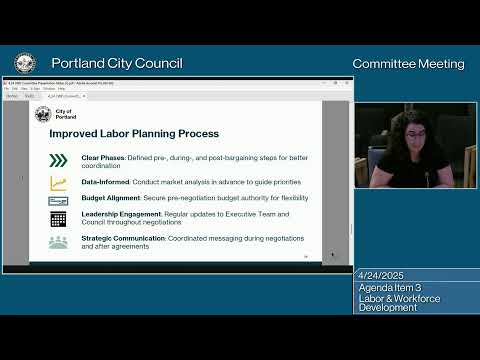
Committee members asked about timekeeping practices and capacity. Councilor Duffy noted some city units still use paper timecards; Warren acknowledged the city is working to modernize those systems but said the realignment and capacity work is ongoing. Councilor Kunal and others urged more regular executive-level updates on bargaining; staff said they will request standing executive-session briefings to provide a regular cadence of confidential updates on negotiations.
Staff said some labor agreements recently ratified (AFSCME, DCTU) and projected health-benefit rate changes will be reflected in the budget process as decision packages, and that impacts vary by fund because many bargaining units are largely non-general-fund. The presenters asked for clearer, earlier engagement with bureau finance managers and council leadership to align budget guidance with bargaining expectations.
The committee requested additional follow-up information on several operational items, including the number of classification changes pending, the status of paper timecard conversion, and a proposed schedule for recurring executive sessions on bargaining.