Get Full Government Meeting Transcripts, Videos, & Alerts Forever!
Get email alerts on the Municipal Budget topic
No spam. Unsubscribe anytime.
Richmond previews FY2025–26 budget, launches online tool to gather community priorities
Summary
City finance staff presented a draft overview of the FY2025–26 budget framework, highlighted a Moody's A2 credit rating and a new 21% general-fund reserve policy target, and demonstrated an online budget-prioritization and simulation tool that will collect public input ahead of a May 6 council draft presentation.
City of Richmond finance and administrative staff on Tuesday evening presented an overview of the proposed fiscal year 2025–26 budget process, described the city’s revenue and spending picture for the current year, and demonstrated a new online engagement and budget-simulation tool intended to collect resident priorities ahead of a May 6 council review.
“I’m deputy director of finance here in the city of Richmond,” Deputy Director of Finance Mubin Kadar said at the start of the meeting, introducing the community engagement session and the online tools staff will use to collect public input.
The presentation emphasized several points staff said are central to the coming budget process. Andrea Miller, director of finance, said, “The city improved its credit rating, with Moody's to A2.” Miller also told the audience that the city has increased its minimum general-fund reserve policy target to 21 percent of expenditures and that the city has established a Section 115 trust to prefund pension and other post-employment benefit obligations.
Why it matters: city officials said the credit rating and reserve policy reduce borrowing costs and strengthen the city’s ability to sustain services if revenues fall. Staff also flagged the city’s federal-grant exposure: Miller said the city currently holds about $62,000,000 in federal grants and is monitoring federal and state developments that could affect those funds.
Revenue and expenditure snapshot Antonio Banuelos, accounting manager, presented the general-fund revenue totals for fiscal year 2024–25 and the structure of the current revenue base. “These revenues for current year 2425, total to close to 249,000,000,” Banuelos said. He said the top three revenue streams — property tax, sales tax and utility-users tax (UUT) — account for roughly $180,000,000, about 72 percent of general-fund revenue. Banuelos explained that Richmond receives a fraction of the 1 percent assessed property-tax levy and roughly 2 percent of the city’s 9.75 percent sales-tax rate.
On expenditures, presenters said the revised 2024–25 general-fund budget is roughly $248,000,000. Staff listed major categories: personnel (salaries and wages) at about $95.2 million, fringe benefits at about $70.6 million, and professional services and other operating costs. Staff showed program-level shares of general-fund spending, with police at about 35 percent, fire at about 18 percent, and public works at about 15 percent.
Non-general funds and capital projects Staff also reviewed the city’s non-general funds — including capital improvement funds, enterprise funds and special revenue funds — and said those funds together represent several large, discrete budgets tracked under governmental accounting rules. Presenters described the capital improvement program (CIP) as active and sizable and noted that project prioritization and timing will be managed separately from the general-fund operating budget.
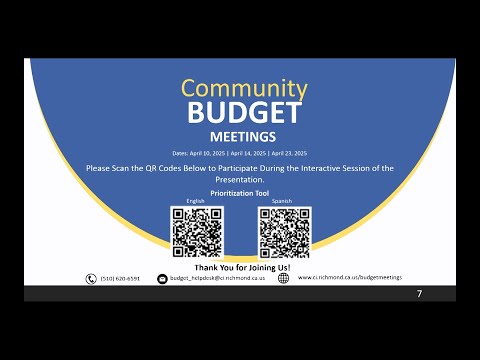
Community engagement tool and timeline As part of the session, staff demonstrated an online prioritization and a budget-simulation tool that allows participants to allocate hypothetical dollars to the council’s six strategic goal areas. Kadar ran a live demonstration and invited in-person participants to try the tool; presenters repeatedly stressed that the exercise was hypothetical and for feedback only.
Mubin Kadar said the portal will remain open through the draft budget schedule and that staff will compile results for the council’s review. Staff listed key upcoming dates: the draft budget will go to council on May 6, a council study session is scheduled for June 3, a budget checklist discussion on June 17, and adoption of the FY2025–26 budget is anticipated on June 24.
Other program and compliance notes Miller noted that the city completed all 11 recommendations from a 2022 state audit and that the city’s long-term financial planning typically covers five-year operating and capital outlooks. Staff also said the Transformative Climate Communities (TCC) program is an active state grant; city staff and an identified program lead described existing contracts with community partners and said staff will seek additional outside funding for any construction-cost shortfalls.
How the city will use input Staff said they will present compiled community responses and comments to council both as part of the May 6 draft-budget packet and in the council presentation. Participants asked whether the incoming data would be analyzed for representativeness; staff said the portal includes an optional residency question but that the tool is not a scientific survey and that staff will report aggregated responses to council.
Where to get more information Staff posted QR codes and a webpage link to the engagement tool, and they said printed and non-digital options (sticky-note boards at meetings) are available for those who cannot use the online portal. Speakers closed by encouraging residents to complete the tool or provide written comments; staff said compiled results will be available as part of the council packet following May 6.