Portland Clean Energy Fund advisory co-chairs urge protection of fund’s investment plan, voice concerns over proposed surcharge increase
Loading...
Summary
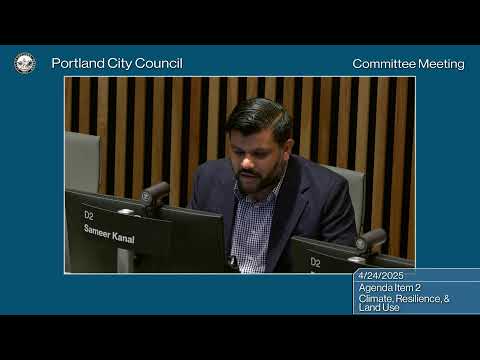
Co-chairs of the Portland Clean Energy Fund community advisory committee told the city’s Climate Resilience and Land Use Committee on April 24 that the committee is wary of a proposed surcharge increase and urged that the fund’s five‑year climate investment plan and set‑aside for community grants be protected.
Portland Clean Energy Fund community advisory co-chairs Megan Horst and Ramfeese told the Climate Resilience and Land Use Committee on April 24 that the advisory body has serious reservations about a proposal to increase the PCEF surcharge and wants stronger guarantees that the fund’s climate investment plan and community grant priorities will be preserved.
Horst, a longtime PCEF advisory co-chair, said committee members see the fund as a unique, voter-approved tool to advance climate justice and resilience and urged council to “keep the climate investment plan intact and keep money that’s dedicated to PCEF towards PCEF.”
The co-chairs framed their remarks as a preliminary “temperature check.” They said the committee has not taken a vote on any surcharge proposal and that their comments reflected preliminary discussion and questions raised at a recent committee meeting. Horst said committee members repeatedly raised concerns that an increase in the surcharge could lead to “mission creep,” and questioned whether protections are adequate to ensure a fixed set‑aside for community grants remains enforceable.
Ramfeese said the committee recognizes the city’s broader budget pressures but cautioned that PCEF — which the co-chairs described as a five‑year climate investment program designed to support greenhouse gas reductions and resilience projects — is “a drop in the bucket” compared with what the city will need to meet climate challenges. He and Horst urged councilors to include the committee early in any amendment process and to use a transparent, public process if the climate investment plan is revised.
Committee members and Horst described the advisory body’s priorities: protecting funding directed to community‑based organizations and priority populations, maintaining an annual review process for the climate investment plan rather than ad hoc changes, and ensuring reliable revenue projections to guide planning. Horst said the advisory committee is composed of nine members (recruitment was underway to fill two additional seats) and that demand for community‑responsive grants is high.
Council members present acknowledged the committee’s concerns. Councilor Carmen Kanel (recorded in the meeting as "Canal") and others asked for more detail about how and why a larger share of PCEF funds has been used for city bureau projects in recent years; the co-chairs said earlier budget decisions and higher-than-expected early revenue projections played a role and that the committee wants better processes and earlier communication when investments change.
Horst and Ramfeese asked that any proposed amendments respect the PCEF code’s amendment process and that the committee and affected communities be formally notified and consulted before changes to the climate investment plan or the surcharge are finalized. Ramfeese said the committee submitted a formal letter to council offices this past week summarizing those expectations.
The co-chairs emphasized the committee’s dual mission — reducing greenhouse gas emissions and enhancing community resilience while centering priority populations, including low‑income communities, communities of color and workers underrepresented in the trades — and said they will continue meeting with council members and staff. They reiterated that the committee’s prior discussion of a surcharge increase was a preliminary review and not a formal recommendation.
The committee’s remarks closed with an invitation for further dialogue; council members indicated they would continue exploring revenue options and meet with the advisory committee one‑on‑one or in committee to address the concerns raised.
Next steps: The PCEF advisory co-chairs said the committee will continue recruitment and hold further meetings; any formal code amendments or surcharge proposals would be expected to return to the advisory committee for review before final council action.