Get Full Government Meeting Transcripts, Videos, & Alerts Forever!
Get email alerts on the Drones And Insurance topic
No spam. Unsubscribe anytime.
Senate committee advances bill to regulate drone use for insurance inspections and critical infrastructure
Summary
A Senate committee moved SB 260 forward after debate about homeowner privacy, insurer practices and industry concerns about operational impacts. The bill would set guidelines for unmanned aircraft over critical infrastructure and for insurers’ use of aerial imagery in underwriting and claims.
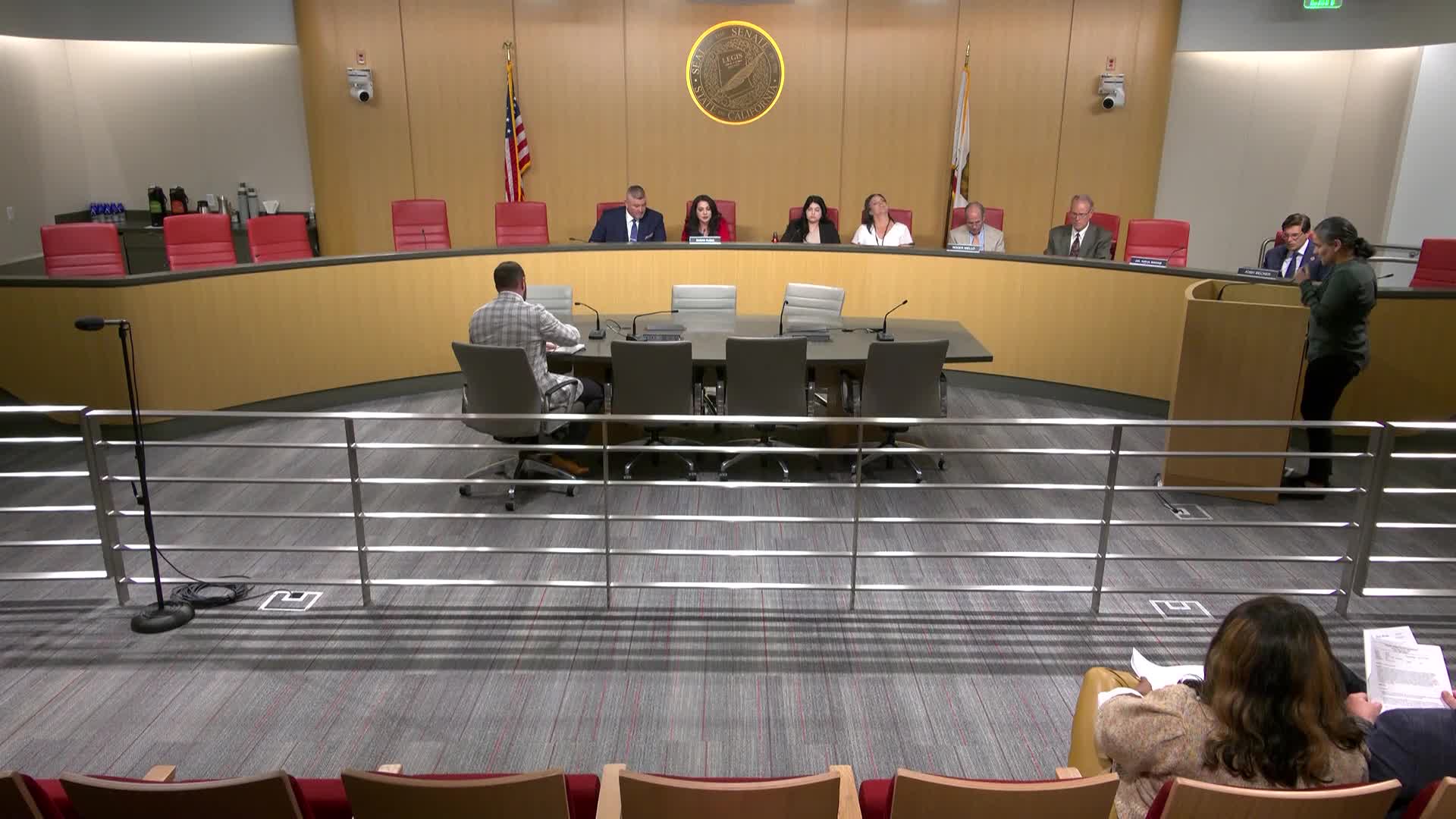
Senators on the California State Senate Committee on Insurance advanced SB 260 on a 4–0 recorded vote to send the measure to the Appropriations Committee after discussion about consumer privacy and operational concerns raised by insurers.
SB 260, authored and presented by Sen. Aisha Wahab, would establish updated guidelines governing use of unmanned aircraft systems (commonly called drones) over critical infrastructure and for insurance uses such as property inspections and claims assessments. Wahab told the committee the bill is meant to close a gap between rapidly evolving drone technology and older state rules, and to provide safeguards for homeowners whose properties may be photographed without notice.
The author and supporters stressed two consumer-protection goals: (1) require notice to homeowners before aerial inspections and (2) limit retention and sharing of images collected without the homeowner’s knowledge. Wahab said the bill’s proposed amendments—shared with committee offices and the Department of Insurance—would be adopted if the bill leaves committee and that she would continue to work with the Department and stakeholders.
Industry witnesses asked for changes. Jonathan Feldman, representing the California Police Chiefs Association, supported protections for critical air infrastructure and said the association also has an interest in privacy protections. Sherry McHugh, Pacific Association of Domestic Insurance Companies, and Denny Ritter, American Property Casualty Insurance Association (APCIA), testified in respectful opposition or asked for amendments. They said several provisions as drafted would be operationally difficult for insurers: the proposed 30-day pre-notification to homeowners, a 120-day “right to cure” period tied to nonrenewal, and a 90-day destruction requirement for images. Insurers said those rules do not reflect how aerial imagery is obtained and stored by third-party vendors, and that regulatory changes should allow for record-retention rules required for market-conduct reviews, fraud investigations, and other statutory obligations.
Witnesses suggested alternatives: include notice in annual renewal documents; replace an inflexible 120-day right-to-cure with a dispute-resolution process; and allow insurers to comply with existing record-retention requirements rather than mandating short destruction windows. Ritter and other insurer witnesses warned that strict restrictions could make aerial imagery unusable for routine underwriting and claims work, raising inspection costs and potentially affecting availability and affordability.
Committee members acknowledged technical trade-offs. Senator Wahab said the bill is a work in progress and reiterated the priority is consumer privacy and giving policyholders an opportunity to remedy issues before a policy is canceled. Several members, including Sen. Becker and Sen. Padilla, encouraged continued negotiations between the author, industry groups and the Department of Insurance.
The committee recorded the motion to move SB 260 to Appropriations. Roll-call entries in the hearing record show Senator Rubio voted “Aye,” Senator Nilo was recorded as “Not voting,” Becker “Aye,” Jones “Not voting,” Padilla “Aye,” and Wahab “Aye.” The author and stakeholders agreed to continue technical discussions as the bill moves forward.