Get Full Government Meeting Transcripts, Videos, & Alerts Forever!
Get email alerts on the Rezoning topic
No spam. Unsubscribe anytime.
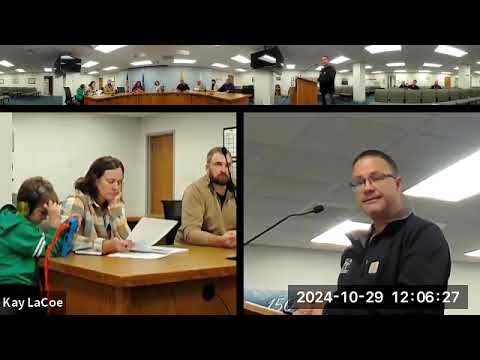
Burleigh County committee discusses rezoning and infrastructure options for Missouri Valley Complex
Summary
A Burleigh County committee reviewed a preliminary zoning request for the Missouri Valley Fairgrounds complex and discussed whether roads and utilities should be public or private, potential easements, stormwater requirements and next steps with the City of Bismarck.
A Burleigh County committee met to review a preliminary rezoning request and early planning concepts for the Missouri Valley Fairgrounds complex, focusing on whether to replat the site as a single public parcel, utility and road ownership, and infrastructure costs and maintenance.
Jason Patricia, a consultant with Slinson Hagen, told the committee the firm had met in a pre-application conference with city staff in Bismarck and was proposing to rezone the site from a Planned Unit Development (PUD) to a public zoning classification. “The zoning and planning process can coincide together,” Patricia said, adding that starting the zoning work now would allow follow-up planning later.
The discussion emphasized two parallel choices: (1) keep the current configuration of lots and rights-of-way, which subjects each lot to separate setbacks and limits flexibility; or (2) consolidate the fairgrounds into a single parcel with a series of access and utility easements to allow shared uses, private roadways and flexible placement of buildings and parking.
Patricia described easements as tools to allow private roadways and centralized utility corridors while avoiding the rigidity of dedicated public rights-of-way: “By having easements, we would be allowed then to have private roadways. We don't have to dedicate a full right-of-way like you have in town.” He said easements would allow the complex to host communal parking, campgrounds and other shared facilities without replatting every time an internal change is needed.
Committee members and staff discussed tradeoffs between private and public ownership of roads and utilities. One committee member summarized the practical difference: private roads and utilities place ongoing repair and replacement responsibility on the property owners or managing entity; public infrastructure places those costs on the city, which can assess property owners over time. Steve (committee member) cautioned the group that with private utilities “the board would be on the hook for any repairs… If somebody ran into a fire hydrant… they had to pay for digging up the water main as well.”
Patricia outlined specific infrastructure and regulatory topics the group should expect during planning: city utility capital charges (meter connection fees), stormwater management scoping (a city “SMO 4” scoping sheet), flood-plain development permits and coordination with county review. He estimated the financial magnitude of meter and connection fees: a 12-inch meter and connection could exceed $100,000, whereas smaller 3/4-inch domestic meters could each trigger capital charges on the order of about $5,000 apiece—meaning multiple user meters could multiply upfront costs for private metering.
The group discussed options to mix approaches — for example, private roadways within easements combined with dedicated public utility easements for a city-maintained water main and hydrants. Patricia said the city would determine the standards for a public road (width, curb and gutter, storm sewer) and could require an up-front paving prepayment for commercial streets (he cited an example of a 40% prepayment policy used in some city commercial/industrial projects).
Committee members repeatedly urged converting the committee’s conceptual preferences into concrete cost scenarios. One member recommended producing side-by-side cost estimates for the committee and county decisionmakers: “If we can show side by side, here's what it's gonna cost under this approach versus that approach, that's going to make the county's job easier,” the member said.
Patricia recommended that the committee pursue a two-track approach: begin the zoning application with the City of Bismarck now to get the city’s preliminary reaction, and continue community-level work sessions and work groups to settle operational questions — governance, maintenance funding, use rules and a possible development agreement to replace or supplement existing leases.
The committee and consultants agreed on near-term process milestones rather than formal decisions. Patricia said the zoning application can be submitted before final platting and that the committee should expect further conversations with city planning staff, the county engineer and other stakeholders on stormwater, utilities and floodplain development. The group discussed holding work sessions and forming a work group that can meet outside normal business hours, subject to open‑meetings requirements.
The discussion closed with agreement to continue the zoning and planning work, complete cost comparisons for public vs. private infrastructure, and convene additional work sessions so stakeholders can return a recommendation to the county and city for later formal approvals.