Get Full Government Meeting Transcripts, Videos, & Alerts Forever!
Get email alerts on the Stormwater Water Quality topic
No spam. Unsubscribe anytime.
Overland Park reports it exceeded NPDES MS4 permit requirements in 2024, outlines outreach and stormwater work
Summary
Public Works staff told the Public Works Committee that Overland Park surpassed the minimum scoring required by the NPDES MS4 permit for 2024 and summarized public education, cost-share grants, inspections and TMDL priorities; the item was presented for information and no council action was taken.
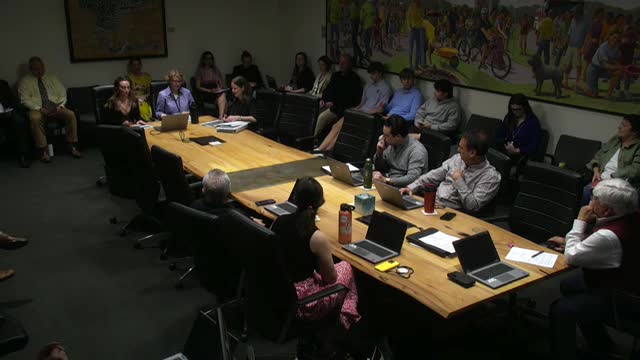
Public Works Director Lorraine presented an overview of Overland Park’s 2024 compliance with the National Pollutant Discharge Elimination System (NPDES) Municipal Separate Storm Sewer System (MS4) permit, saying the city exceeded the permit’s point requirements and summarized work on public education, illicit-discharge detection and Total Maximum Daily Load responses.
The report, delivered as an informational item to the Public Works Committee, said the MS4 permit is organized around six minimum control measures plus TMDL-related monitoring and requires periodic reporting to the Kansas Department of Health and Environment (KDHE). Staff said the current permit cycle runs through Dec. 30, 2026, and the city achieved 105 points where 45 points are required.
City staff described major programs and results from 2024: public education and outreach that reached residents and students; a stormwater cost-share program partnered with Johnson County; illicit-discharge detection and dry-weather monitoring; erosion and sediment controls tied to land-disturbance permits; operation and maintenance measures at municipal facilities; and work on TMDLs and the state 303(d) listing process.
Among the figures presented: the June Bug Ball at Deanna Rose Farmstead drew about 890 attendees and a Healthy Yards Expo drew roughly 1,300 attendees in 2024; K–12 water-quality education reached more than 6,000 students through partnerships with Blue Valley and Shawnee Mission school districts. The stormwater cost-share program, matching Johnson County funds, had $30,000 in total program funds in 2024 (city contribution $15,000), served 92 participants and supported installation of more than 120 best-management practices; staff said two projects were deferred to 2025 because funding was exhausted and 29 applications had been submitted so far in 2025.
For illicit-discharge work, staff said Overland Park’s municipal code 7.58 supports pollution response and the city’s OP CARES reporting; staff reported the city inspected more than 25% of its roughly 1,000 outfalls in 2024. On erosion control, staff reported issuance of 31 land-disturbance permits for projects disturbing more than 1 acre, covering more than 50 acres in total. The city also reported more than 850 privately owned stormwater treatment facilities within city limits and routine inspections of municipal facilities (monthly for five identified high-risk facilities, biannually for other city facilities). Street sweeping covered 100% of city streets at least once, staff said.
On TMDLs and the Kansas 303(d) list, staff noted streams listed in the city’s watershed as having impairments and requiring BMPs: Indian, Tomahawk, Wolf and Coffee creeks were cited for bacteria, and Wolf and Coffee creeks for nutrients and sediment. Staff also noted Turkey Creek listed for ammonia, Indian Creek for bacteria and diazinon (an insecticide) and the Blue River listed for bacteria, diazinon and biological impairment; Johnson County conducts monitoring and reports results to KDHE, and city BMPs are intended to address the priority pollutants identified.
Staff emphasized that the program’s approach is incremental and focused on preventing further degradation, tracking pollutants where possible, and using watershed studies and pilot projects on public land to measure benefits. The MS4 annual report and the 2025 Stormwater Quality Management Plan are available on the city’s stormwater webpage, staff said.
The item was informational; committee members asked clarifying questions about how watershed study recommendations would be incorporated into the capital improvement program, the staffing and training approach for high-risk municipal facilities, and whether the city felt prepared for a possible U.S. EPA audit. Staff said they conducted a mock EPA-style audit and felt reasonably prepared but would continue to coordinate with county and state partners.
The presentation credited Public Works staff for their work and closed with a reminder that more detailed materials and the full annual report are posted on the city’s stormwater webpage.