Get Full Government Meeting Transcripts, Videos, & Alerts Forever!
Get email alerts on the Public Space And Homelessness Policy topic
No spam. Unsubscribe anytime.
Fort Smith revisits proposed ordinance on sleeping and camping on public property; sends draft to city attorney for revisions
Summary
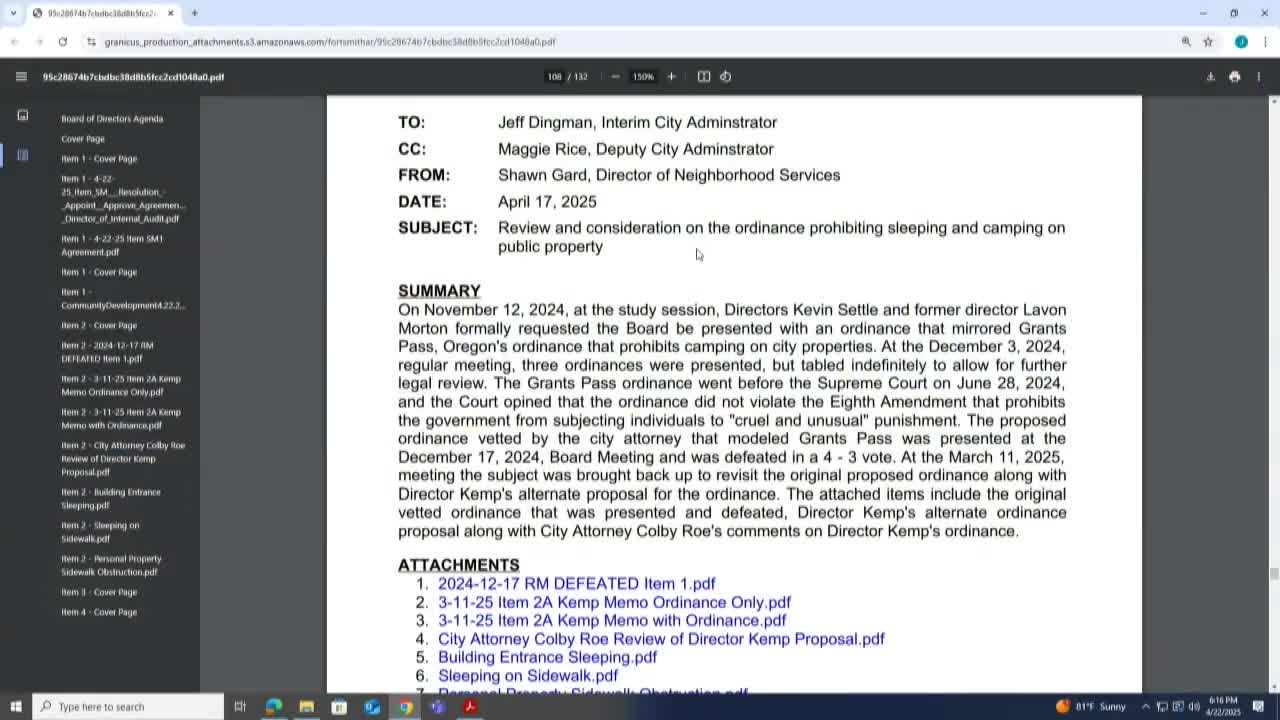
City staff and directors debated a proposed ordinance modeled on Grants Pass, Ore., that would prohibit sleeping and camping on public property. Directors instructed City Attorney Colby Rowe to review and refine language to address vagueness and constitutional risk before the board considers it again.
The Fort Smith board reviewed a proposed ordinance that would prohibit sleeping and camping on sidewalks and other public property, a topic the board previously considered in December 2024 and again at a March 11 study session. Sean Gard, director of Neighborhood Services, summarized enforcement concerns and explained the city attorney had reviewed an alternate draft from Director Lee Kemp and warned that some language could be vulnerable to legal challenge as vague.
Gard said nuisance ordinances currently cover camping materials such as tents and tarps but do not specifically prohibit the act of sleeping on public sidewalks; he described recurring encampments and daily incidents of people sleeping in building foyers and alcoves. Gard also described a recent cleanup at a site near the Next Step Day Room where a contractor provided pro‑bono clearing assistance and paid some people to help.
Police Chief (surname not specified) told directors that his staff reviewed the proposed ordinance and raised legal and enforcement concerns similar to those noted by City Attorney Colby Rowe. Chief Baker (as identified) said existing criminal trespass statutes cover sleeping on private property when owners have posted or objected, but the proposed public‑space prohibition would need clearer drafting to withstand court challenge.
Directors debated the balance between enforcement and services. Director Christina Kitsavas and others urged involvement from local nonprofits such as Hope Campus; Director Lee Kemp said the intention of his draft was “service based” and not meant to criminalize homelessness. Several directors asked Rowe to add clarifying language and resolve apparent internal inconsistencies between sections; the board agreed to send the draft back to Rowe for revision and to revisit the item after budget discussions and further legal edits.
No ordinance vote occurred at the meeting. Board members said they want the final draft to be concise, enforceable, and consistent with constitutional requirements and local service capacity before any formal adoption attempt.