Get Full Government Meeting Transcripts, Videos, & Alerts Forever!
Get email alerts on the Capital Investment Plan topic
No spam. Unsubscribe anytime.
Orange County reviews $76.3 million first-year capital plan; commissioners press staff on schools, crisis diversion facility and elections storage costs
Summary
The Orange County Board of Commissioners reviewed the first-year items of a proposed 10-year Capital Investment Plan totaling $76.3 million for fiscal year 2025–26, focusing discussion on a behavioral health crisis diversion facility, school project funding and a cost increase for a climate-controlled elections storage addition.
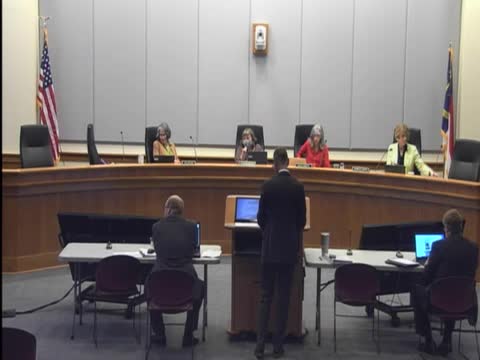
Orange County commissioners held a work session April 22, 2025, to review the recommended first-year projects in the county’s 10-year Capital Investment Plan (CIP), a package that staff said totals $76.3 million for fiscal year 2025–26. The board discussed a mix of county facility upgrades, vehicle and IT replacements, parks projects and school capital priorities; no final budget adoption took place at the session.
The CIP’s year‑one breakout presented by staff shows $38.5 million in county capital projects and $34.1 million in school capital. Staff said the single largest county line item in year one is the Behavioral Health Crisis Diversion Facility, which accounts for about $22.7 million of the county total. The board also reviewed dozens of smaller maintenance and improvement projects across county facilities and parks.
Why it matters: the first year of the CIP determines year‑one appropriations and informs the county’s debt-service model and tax-impact projections. Commissioners pressed staff for clarifications about project scopes, contingencies, timelines and alternatives for items that carry high costs or uncertain funding, including school projects that will be partially funded with pay‑as‑you‑go (PAYGO) cash and proposed bond proceeds.
Most important details
• CIP totals and major drivers. Staff presented a year‑one recommended CIP total of $76.3 million, with $38.5 million of county capital and $34.1 million for schools. The Behavioral Health Crisis Diversion Facility is the largest single county project in year one (about $22.7 million). Staff said school capital includes the final installment of a supplemental deferred-maintenance program and planning/design funds for replacement schools.
• Crisis diversion facility: purchase complete; preconstruction underway. County staff confirmed the land purchase is complete and preconstruction services with a construction manager at risk (CMAR) have started. Commissioners were told that $285,000 was advanced from next year into the current fiscal year to cover early work; staff explained the $285,000 includes approximately $180,000 for preconstruction services, $35,000 as a payment‑in‑lieu to the Town of Hillsborough for future road connection work and the remainder for closing and permit costs. Staff said additional guaranteed maximum price (GMP) approvals will be brought to the board in stages with a final GMP expected in winter 2025, and construction expected to start in six to eight months with operations by early 2027.
• Animal Services improvements. The Animal Services project was described as two-part: roughly $514,460 tied to Department of Agriculture recommendations required to retain accreditation, and about $304,260 for discretionary operational improvements. Commissioners asked staff to flag the accreditation‑critical items separately, which staff did.
• Board of Elections storage cost escalation. A proposed climate‑controlled expansion to store voting equipment grew after market testing; staff said the estimate increased by $381,000. Angel Barnes, the county’s Capital Projects Manager, explained the rise was driven in part by the small size of the addition (contractors charging more per square foot) and facade work because the site is in a historic district. Commissioners discussed alternatives, including locating equipment in other county buildings, but staff said the Board of Elections strongly prefers co‑location with its staff for security and operational reasons. Staff said the planned expansion is roughly 1,200 square feet.
• Climate mitigation, resilience and solar grants. Commissioners reviewed an updated Climate Change Mitigation Program and a staff proposal to detach the grant line from a fixed property tax fraction; staff proposed holding the grant at last year’s amount with a 2% annual increase. Amy Eckberg, the county’s Sustainability Manager, said the county just received a state Office of Energy grant to install solar at Cedar Grove Community Center for nearly $200,000 and discussed plans to evaluate community centers and senior centers as resilience hubs with solar plus battery backup. Staff also proposed $212,000 in year‑one funding for resilience hub work (solar/battery and other resilience features).
• Electric‑vehicle planning and charging. The board discussed a proposed $100,000 electric vehicle (EV) and infrastructure study to set a fleet‑conversion roadmap, identify charger locations, and advise on procurement approaches (lease vs. buy). Staff noted average installed cost per charger of about $20,000 and said the study would guide placement and electrical capacity planning for a proposed 16 EV charging stations; commissioners asked the study also to compare per‑mile operating costs and lifecycle expenses of existing EVs versus gas vehicles.
• Facility big-ticket items and deferred‑maintenance scheduling. Commissioners reviewed multi‑year electrical, mechanical and roofing schedules for county facilities (including West Campus and Passmore Center), and discussed whether some planned projects could be deferred if inspections showed no immediate safety issues. Staff said the recommended electrical replacements follow industry lifecycles and that many buildings are approaching the 20‑year replacement horizon.
• Evidence storage and Link Building option. Staff said that further work on the county’s evidence storage project could reduce the off‑site building from 10,000 square feet to 6,000 square feet (cost estimate roughly $2.4 million) if the sheriff’s office moves evidence storage into capacity at the Link Building; staff committed to returning a sequencing/timing amendment for board consideration.
• Fleet and emergency services vehicles. The CIP includes $3.5 million for vehicle replacements, about $2.0 million of which staff said would be for emergency‑services vehicles; the fleet plan includes money for three ambulances in the replacement cycle and replacement funds for sheriff’s vehicles (a lump sum of about $598,000 for sheriff priorities). Staff noted lead times and market uncertainty and suggested delaying purchase orders into the first fiscal quarter while monitoring market conditions.
• Parks and large projects. Commissioners queried cost escalations on projects such as the Rogers Road Community Center (presented cost estimate increased toward $2.89 million for a two‑story solution given site constraints) and Lake Orange Dam rehabilitation (multi‑year; staff said federal funding applications would be pursued but a FEMA program referenced in the packet has been eliminated). Commissioners requested additional work sessions on large parks decisions and on properties such as Millhouse Road Park.
• Schools, PAYGO and bond sequencing. Staff described changes in how school capital is presented: three major projects (district requests) plus a project‑based approach for high priority needs and other capital uses. Staff proposed phasing PAYGO funding (staff called it $6.4 million in year one, rising in later years toward a $10 million target over the 10‑year horizon) to absorb soft costs (design, project management) and reduce borrowing. Commissioners discussed four options for PAYGO sequencing (reduce early‑year PAYGO and move funds to later years; reduce PAYGO without adding funding; delay projects a year; or eliminate PAYGO). Several commissioners said they prefer keeping as much PAYGO as feasible to pay for design, management and to limit negative impacts on debt metrics; others said they wanted more complete operating/budget detail before choosing. Staff noted statutory and timing constraints on bond authorization (construction borrowing windows) and said specific school project schedules can affect whether PAYGO is needed in year one. Staff agreed to model different timing scenarios at commissioners’ requests.
What the board directed and next steps
Staff were asked to return with: (1) a staff amendment reflecting the $285,000 timing change for the crisis diversion preconstruction work; (2) refined cost breakdowns for the Board of Elections storage option and any reasonable alternatives; (3) updated project inspections and timing justification for candidate deferrals on major electrical and roofing items; (4) an EV‑infrastructure study scope that includes lifecycle cost comparisons; (5) options and timing for evidence storage tied to Link Building sequencing; and (6) modeled debt/ tax impacts for several PAYGO/bond sequencing scenarios for school projects. Staff said a final budget adoption and intent‑to‑adopt hearing will be scheduled before the budget adoption meeting (the packet referenced June 17 as the adoption meeting date), and staff will post amendments online for public review. The schools’ staff and boards will present further details at an upcoming joint meeting and at the May 15 work session.
Quotes from the meeting
"I have not had a fever for 5 days. I tested negative this morning," said Commissioner McKee during early procedural remarks.
"Due to how small the addition is, the contractors are charging more, per square foot," said Angel Barnes, Capital Projects Manager, explaining why the estimated cost for the elections storage expansion rose.
"We just received a grant to get solar on Cedar Grove Community Center, for almost $200,000 through the state Office of Energy," said Amy Eckberg, Sustainability Manager, describing a new award the county will use toward resilience hub work.
Meeting close
No formal adoption of the CIP occurred at the work session. The board concluded the work session after staff agreed to return with the requested amendments and models; the session ended with a routine adjournment vote.