Get Full Government Meeting Transcripts, Videos, & Alerts Forever!
Get email alerts on the Development Impact Fees topic
No spam. Unsubscribe anytime.
Newman City adopts updated nexus study, raising development impact fees
Summary
Newman City Council adopted a resolution approving the 2025 citywide capital facilities development impact fees nexus study, updating multiple fee components and increasing typical single‑family impact fees from about $16,000 to roughly $37,000; council vote was 3–0 with two members absent.
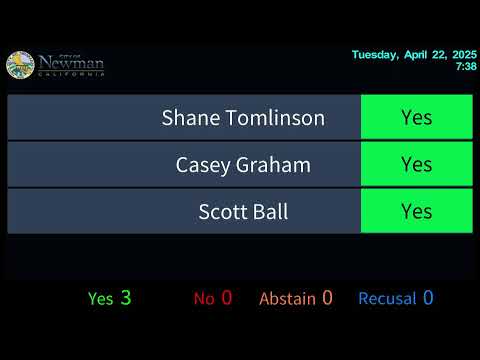
The Newman City Council on April 20 adopted a resolution approving a 2025 citywide capital facilities development impact fees nexus study that updates how the city charges new development for facilities and infrastructure. The council voted 3–0, with two members absent.
The study, prepared by Economic and Planning Systems (EPS), revises the city’s fee program across nine components including fire, police, general government, transportation, sewer, storm drainage, water and program administration. Amy Lappin, principal with EPS, told the council the update is intended to “reestablish nexus, meaning a reasonable tie to any of the fees that we’re going to collect,” and to meet the procedural requirements of the state’s mitigation fee statute and related guidance.
The consultants and staff said the update reflects changes since the city’s last comprehensive update in 2002 and incorporates new master plans, cost estimates and development forecasts. Allison Schaeffer, an EPS consultant, explained the study’s methodology: demographic and land‑use projections, identification of capital facilities needed to serve projected development, cost estimates and allocation of those costs to land uses. She said the residential fees comply with Assembly Bill 602 (AB 602) by charging by residential square‑foot ranges except where statute exempts a component (water and sewer).
The study establishes residential square‑foot ranges for some components (<750; 750–999; 1,000–1,999; ≥2,000) and sets average unit sizes used in comparisons (multifamily 750 sq. ft.; single‑family 1,700 sq. ft.). Fees for nonresidential uses are set per 1,000 building square feet; water fees vary by meter size. An administrative component of 3% is added to each fee component for program administration.
EPS presented comparisons showing most fee components increased. The consultants cited updated water and sewer master plans, new capital projects and higher construction costs as principal drivers. The presentation noted an illustrative comparison in which an average single‑family fee rose from about $16,000 under current charges to roughly $37,000 under the proposed schedule.
A member of the public asked whether the more‑than‑200% increase would affect housing prices. Lappin and staff responded that developers typically account for fees in land pricing and that the city’s legal standard is that new development pay its fair share rather than transfer those costs to existing residents. A city staff member, Michael, told the council the city is planning major sewer upgrades and that the primary‑sphere cost estimate for sewer improvements is in the $16–20 million range; he also noted a recently built well and tank cost about $9 million.
Council members and staff emphasized that the Nexus study was developed with outreach to the building industry and developers; EPS said it circulated a draft, met with the local Building Industry Association and incorporated feedback from a developer (John Beckham) whose written approval of the final report appears in the council packet. The presentation also noted the city’s parks master plan is being updated separately and park‑related fees were not revised in this study.
Adoption of the nexus study establishes the legal findings required to implement the updated fee program. EPS and staff noted AB 602 increases public accountability for fee studies and allows members of the public to challenge compliance with the Mitigation Fee Act. The council’s approval triggers the administrative steps needed to record and implement the new fee schedule.