Get Full Government Meeting Transcripts, Videos, & Alerts Forever!
Get email alerts on the Housing Affordability topic
No spam. Unsubscribe anytime.
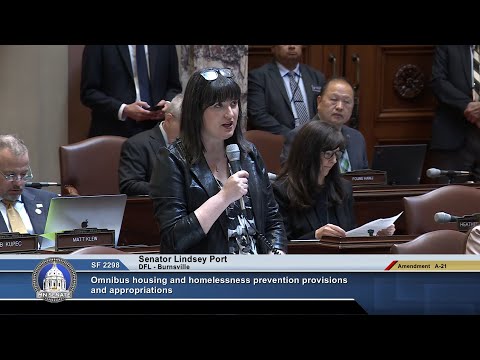
Senate passes housing omnibus after heated debate over cap on rent increases for some tax-credit projects
Summary
The Minnesota Senate on April 22 passed an omnibus housing and homelessness bill after adopting an amendment that limits rent increases at some federally tax‑credited properties, a move supporters called targeted relief and critics called rent control.
Saint Paul — The Minnesota Senate on April 22 passed an omnibus housing and homelessness bill after a prolonged floor debate over a targeted limit on rent increases for some federally tax‑credited properties.
Senate File 2298, the Omnibus Housing and Homelessness Prevention Policy and Appropriations Bill, was carried on the floor by Senator Port. The chamber adopted an amendment offered by Senator Abler that supporters described as narrowly aimed at projects that received federal low‑income housing tax credits and that opponents called rent control. The amendment passed on a roll call, 38‑26. The bill’s final passage later passed 40‑24.
The amendment adopted as A22 would limit annual rent increases for properties awarded federal tax credits to a formula described on the floor as “the lower of area median income or the Consumer Price Index,” according to Senator Abler’s explanation on the floor. Abler said the change was intended to give “a thimbleful of relief” to seniors and other residents in regulated affordable housing who she said have seen rents rise faster than incomes.
Senator Port, the bill author, framed the overall package as a mix of homelessness prevention, workforce housing support for Greater Minnesota and programs to help first‑time buyers. “The cost of housing is higher than ever in Minnesota,” Port told the chamber when she introduced the bill, and she described investments in rental assistance, manufactured‑home resources and a “first generation down payment assistance” program included in the measure.
Opponents argued the A22 amendment amounted to rent control and would discourage investment. “This is rent control,” Senator Rasmussen said on the floor, citing the city of St. Paul’s prior experience and warning of fewer housing options and cancelled developments. Senator Gruenhagen and others argued broader market and cost pressures — construction, property taxes and insurance — drive housing costs and that targeted caps could chill development.
Other supporters cast the amendment as narrowly tailored to projects that accepted federal tax credits and therefore taxpayer support. Senator Duckworth said she opposed broad, statewide rent control but that “when we're talking about trying to help a very targeted group of individuals, namely the elderly, ... I think there are things that we have to give some consideration to.” Senator Hoffman urged colleagues to “do the right thing for gramp and grandma.”
Floor debate also produced several other adopted changes to the bill. Senator Lucero’s A12 amendment, adopted by voice vote, would prohibit counties from charging a recording fee to remove historical racial restrictive covenants from property titles. Senator Drayheim’s A17, also adopted, requires a review of the state’s community‑based first‑generation homebuyer down payment assistance program. A technical A21 amendment to clarify membership and objectives of an insurance task force was adopted as amended on the floor. Several other proposed amendments were withdrawn or ruled not germane by the presiding officer.
The chamber’s final roll call on the bill showed 40 ayes and 24 noes; the secretary announced the bill passed and its title was agreed to. On the floor, proponents emphasized the bill’s mix of homelessness prevention funding, infrastructure for workforce housing in Greater Minnesota and homeownership assistance. Critics pressed for clearer metrics tying prior spending to outcomes and warned that regulatory and cost pressures — from utilities to insurance — constrain affordability.
What the bill does not change on the floor: none of the votes or debate on A22 changed state law for properties that are not part of the federal tax‑credit program. Several senators repeatedly noted the amendment’s sponsors intended it to apply only to developments that accepted the federal Low‑Income Housing Tax Credit. Senator Abler said nonparticipating landlords, nonprofit operators and landlords that did not accept federal tax credits would not be affected.
The bill as passed creates or funds multiple programs through the Minnesota Housing Finance Agency and includes policy directions and task‑force work on homeowners’ insurance costs. Supporters said the bill builds on major investments made in 2023 and 2024, while opponents said the Legislature should prioritize reforms to reduce construction and operating costs that drive prices upwards.
Votes at a glance (selected floor actions tied to this bill) • A22 (Abler) — Amendment to limit annual rent increases on projects awarded federal tax credits to the lower of area median income or CPI: adopted by roll call, 38 ayes, 26 noes. • A12 (Lucero) — Prohibit county recording fees for removing racial restrictive covenants from titles: adopted (voice vote). • A17 (Drayheim) — Require review/evaluation of community‑based first‑generation down payment assistance program: adopted (voice vote). • A21 (Port, technical) — Clarify insurance task force membership and objectives (as amended): adopted (voice vote). • Final passage — Senate File 2298 as amended: passed by roll call, 40 ayes, 24 noes.
Implementation notes: sponsors repeatedly said A22 applies only to projects that accepted federal tax credits (Section 42 LIHTC) and to units subject to those program requirements; the federal program and related federal decisions can affect how the provision operates in practice. Several senators warned that longer‑term solutions require increasing housing supply and addressing drivers of construction and operating costs.
The Senate moved on after final passage; the bill will proceed to conference or enactment steps specified in the legislative process.