Get Full Government Meeting Transcripts, Videos, & Alerts Forever!
Get email alerts on the Marijuana Tax topic
No spam. Unsubscribe anytime.
New Castle County council urges General Assembly to allow county sales tax on retail marijuana products
Summary
The council approved Resolution 25-070 asking the Delaware General Assembly to authorize New Castle County to levy a local tax (proposed 3%) on retail marijuana sales to fund public safety and workforce programs; the measure passed 10–2 with public testimony both for and against.
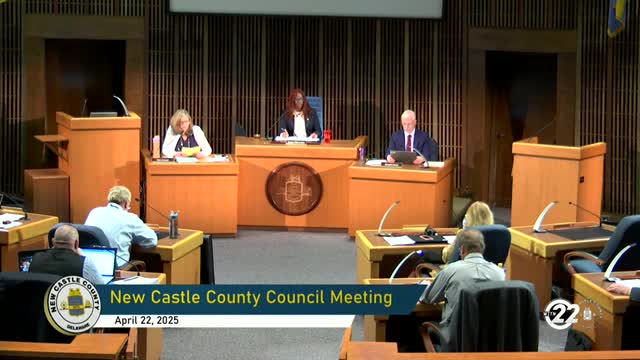
New Castle County Council on April 20 approved Resolution 25-070 urging the Delaware General Assembly to authorize the county to levy a local tax on retail marijuana products, a measure sponsors said could raise roughly $4.5 million to $6 million annually at higher rates. Councilman Koneko introduced the resolution; the council approved it on a roll-call vote, 10 yes, 2 no, 1 absent.
The resolution requests state authorization for a county tax in addition to the 15% state tax on retail marijuana sales. Councilman Koneko, the motion’s sponsor, said the county’s finance staff estimated a 3% local tax would yield “about 4 point something million dollars” and that a higher local rate could approach $6 million. Councilwoman Kilpatrick, a co-sponsor, said the money would be directed to public safety and programs such as youth workforce development and job training already in place but currently underfunded.
The measure drew extended debate from council members over state preemption and recent pending legislation in Dover. Multiple council members said Senate Bill 75 (SB 75) and related actions in the General Assembly could change local land-use controls for marijuana dispensaries, requiring additional county staff time and analysis. Councilman Carter said the resolution was intended to force conversations with state lawmakers after what he called an “unfunded mandate” from Dover; he said he supported the resolution but warned that future changes at the state level could affect his support if they imposed extra burdens on county staff.
Public commentators were divided. Emily Wilkins, vice president of First State Compassion and DelTech workforce development instructor, told council, “I strongly disagree with this resolution,” arguing an added county tax would push customers to out-of-state or illicit markets and hurt industry employees. Jennifer Stark, a Delaware Cannabis Industry Association member and retail business owner, invited council members to “come visit our stores” and described security, surveillance and regulation in the licensed market. Matthew Kersey, a conditional grow applicant, warned that higher combined taxes would make the state less competitive with neighboring states. Dora Williams, a Rose Hill Gardens resident, said she “agree[d] with the tax” but opposed having retail sales in her disadvantaged community and questioned whether benefits would outweigh harms. Tracy Sutherland, who holds conditional social-equity facility licenses, urged reallocating portions of the existing 15% state tax to the county rather than adding a new local tax.
Council discussion repeatedly referenced SB 75 and the Marijuana Control Act; sponsors said the resolution asks the county’s legislative delegation to allow a county-level option, not to impose tax language unilaterally. The item’s outcome does not change state law — council members and speakers repeatedly noted that implementation would require action by the Delaware General Assembly and, if passed there, the governor’s signature.
Votes and next steps: the council adopted Resolution 25-070 and instructed sponsors to pursue intergovernmental discussions with Wilmington and Sussex County, and to coordinate with county staff before testifying in Dover. No specific ordinance or local tax rate becomes effective without subsequent state authorization and any required county implementing ordinance.
Why this matters: sponsors argued the revenue could fund public safety and workforce programs affected by legalization, while opponents said additional taxation risks boosting the illicit market and harming legal operators already carrying heavy compliance costs. The item illustrates friction between county land-use work and the state legislative process as Delaware establishes its regulated adult-use market.