Get Full Government Meeting Transcripts, Videos, & Alerts Forever!
Get email alerts on the Public Safety Finance topic
No spam. Unsubscribe anytime.
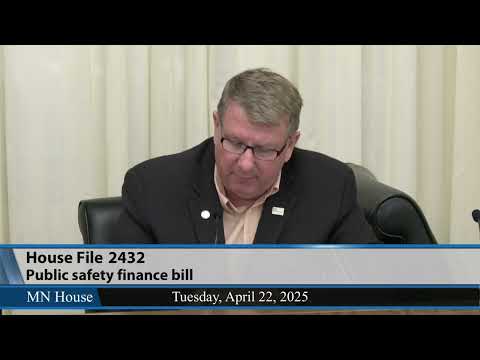
Committee advances public safety finance bill with $50 million biennial target; House File 2432 recommended to general register
Summary
The Minnesota House Public Safety Finance Committee on an oral voice vote recommended House File 2432 to the general register after co-chairs said the panel met a target of an additional $50 million above the February forecast base for fiscal years 2026–27 and the same amount in the forecast tails.
The Minnesota House Public Safety Finance Committee on an oral voice vote recommended House File 2432 to the general register after co-chairs said the panel met a target of an additional $50 million above the February forecast base for fiscal years 2026–27 and the same amount in the forecast tails.
Staff member Adrienne, summarizing the committee’s target and outcome, said, “For the Public Safety Finance Committee, the target they received was an additional $50,000,000 over the February forecast base for fiscal years '26 and '27 ... And they did meet those numbers.”
The bill packages operating increases and targeted spending that committee co-chairs described as intended to prioritize officer recruitment and training, victim services and certain Department of Corrections (DOC) costs while acknowledging the package does not fully cover agency operating requests. Representative Novotny, a committee co-chair, said the committee’s target was measured against agency requests that now exceed $120 million, much of it fixed costs tied to union-negotiated contracts.
Key allocations described to the committee include: $5,500,000 each year to the Philando Castile training fund; funds for duty-to-intercede training (stated in the hearing as $500,000 a year and $500,000 for the first year); $2,000,000 for an intensive police officer training program; and $1,000,000 each year for local public safety radio equipment described in the hearing as “armor.” Committee members also said the bill includes $16,000,000 for crime victim funds and $1,400,000 for the Bureau of Criminal Apprehension fraud unit; the bill reduces the governor’s proposed funding for a “sentence to serve” program by $3,500,000 and reallocates $18,000,000 to agency operating increases. The committee created a special revenue account intended to stabilize some victim services funding after federal and fines-based revenue sources declined, the co-chairs said.
Committee members raised concerns that the bill’s biennial operating adjustment falls short of agency needs. Representative Mueller, the committee’s other co-chair, said the department operating adjustments totaled larger sums in agency requests and warned the smaller adjustment will “impact their service levels, things like processing evidence in a timely fashion.” Mueller added in committee discussion that preserving rehabilitation programming and supporting corrections officers was a priority: “making sure people have those family connections really helps with rehabilitation and also helps children be able to maintain contact with their family members who might be incarcerated.”
Members discussed funding previously added to the base for inmate phone calls. Representative Novotny said, “I believe we fund 3,000,000 a year for that,” and later said he had been informed roughly $2.2 million of that covers the actual cost of calls, with remaining revenues formerly offsetting items such as cable television and recreational equipment. Novotny told the committee cable TV costs run “about a million dollars a year.” Members said federal or carrier-level caps on call costs may reduce future costs and free up funds for other needs.
Representatives Scott, Yoo and Poggi each spoke in support of preserving funding for phone calls and in favor of rehabilitation-focused spending; Scott and others said they would support the bill despite concerns about the remaining shortfall for DOC operating needs.
Procedural motions: Representative Scott moved to incorporate language from House File 2300 as amended into the public safety and judiciary omnibus as separate articles; that motion carried on a voice vote. A subsequent motion to incorporate House File 2432 into the omnibus also carried on a voice vote. Finally, Representative Novotny renewed his motion that House File 2432, as amended, be recommended to the general register; the committee approved the recommendation and directed nonpartisan staff to make technical corrections to the title. The committee recorded the votes as voice votes (ayes), with no roll-call tallies provided in the transcript.
The bill now proceeds as part of the public safety and judiciary omnibus and was recommended to the House general register. Nonpartisan staff will make technical corrections to the bill’s title before further action.