Get Full Government Meeting Transcripts, Videos, & Alerts Forever!
Get email alerts on the Executive Session Conflict Of Interest topic
No spam. Unsubscribe anytime.
Josephine County commissioners disclose potential conflicts, move to executive session on property and lease matters
Summary
At a county administrative workshop, commissioners disclosed potential conflicts of interest including involvement with a mining advisory committee and then entered executive session under ORS 192.660(2)(e) and (h) to discuss three property and lease items; accredited media were allowed but instructed not to report deliberations.
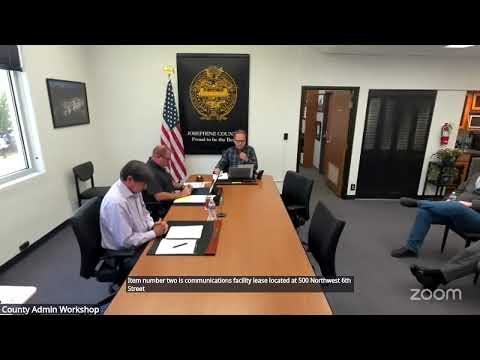
At about 1:30 p.m. during a county administrative workshop, the Josephine County Board of Commissioners opened with disclosures of potential conflicts of interest and then recessed into an executive session to consider real-property and lease matters, according to the meeting transcript.
The disclosures came during the meeting’s first agenda item, “declaration of potential conflicts of interest.” Commissioner Smith said he had reviewed the agenda and “see[s] no conflicts of interest, but there could be one of the things on me maybe because I live there.” Commissioner Barnett said he is “a resident business owner of Josephine County” and that although that could present a potential conflict, he did not see a conflict on the day’s agenda. An unnamed presiding official disclosed that they had served on the county’s mining advisory committee and had “acted as the chair” and been involved in a recommendation related to a draft ordinance concerning the county mining ordinance, listed on the agenda as item 4(a).
The nut of the workshop was an executive session announced under Oregon Public Meetings Law for the following subjects: review of real property (cited as ORS 192.660(2)(e)), a communications-facility lease at 500 Northwest Sixth Street (cited as ORS 192.660(2)(e)), and county-owned property at 3783 Holland Loop Road (also cited as ORS 192.660(2)(e)); the facilitator also referenced the subsection commonly cited as ORS 192.660(2)(h) in the announcement. The board directed accredited representatives of the news media and designated staff to remain for the executive session but specifically instructed them not to report or disclose the substance of deliberations; the meeting notice and transcript state that “no decision may be made in the executive session.” The meeting recorder and other recording devices were directed to be turned off before the session began.
The transcript includes two agenda references that were clarified during the disclosures: an agenda “correction” item and a draft ordinance recommending changes to the county mining ordinance (referenced as ordinance 5.15). The presiding official identified prior involvement on the mining advisory committee and chairing that body as the basis for disclosing a potential conflict tied to that ordinance recommendation.
No formal vote or final decision is recorded in the available transcript excerpt. The board’s stated procedure — permitting only accredited media and designated staff to attend an executive session under ORS 192.660 while prohibiting reporting on deliberations — was followed in the transcript, which shows the board moving into executive session at about 1:31 p.m. The transcript does not record the outcome of the executive session or any subsequent open-session actions.
Future public records or minutes released after the executive session may show whether any formal action followed; the transcript excerpt provided does not include a return to open session or any votes.