Get Full Government Meeting Transcripts, Videos, & Alerts Forever!
Get email alerts on the Land Use Development topic
No spam. Unsubscribe anytime.
Council gives preliminary support to Hand Track plan, asks staff to draft development-agreement details
Summary
Rosenberg council signaled majority support for amending the Brookwater development agreement to add roughly 396 acres proposed as the Hand Track subdivision, with conditions on lot sizes, street widths and a city-limit reconfiguration; council directed staff and the developer to refine the agreement for a future formal action.
Rosenberg Mayor William Benton and a majority of city council members on Tuesday signaled support for folding a proposed single‑family development, called Hand Track, into the existing Brookwater development agreement — subject to further negotiations and technical edits.
The developer, represented by attorney Richard Moller and a Beazer Homes team, asked the council to let the new land be developed under Brookwater’s standards with two specific modifications: require a portion of 70‑foot lots, and accept a compromise street width of 32 feet instead of the city’s current 36‑foot standard. The application covers roughly 396.8 acres split between the city limits and the city’s extraterritorial jurisdiction (ETJ).
The request matters because, as Moller told the council, the current city‑limit strip runs through the tract and “is not very conducive to lot layout,” creating a patchwork where one side of a street could be inside the city and the other side outside. Moller said his team proposes to “reconfigure the city limit” so the project reads as a single, cohesive neighborhood and to guarantee minimum percentages of larger lots inside the city portion.
Council members pressed the developer and staff on several points: whether annexation would be preferable, who would maintain detention ponds within the revised city limits, and how many homes would be taxable city property under the proposal. City planner Rigo and the development team said the change would give the city the right to annex the area in the future, that Brookwater or the municipal utility district would generally maintain infrastructure, and that the revised plan includes about 788 lots with widths ranging from 40 to 70 feet and a minimum of 10% 70‑foot lots in the area that would remain (or later become) city territory.
Councilmember concerns centered on the amount of detention (stormwater) located inside the city after the reconfiguration, and on maintaining consistent street and lot standards across the wider Brookwater community. Several council members said they would reluctantly accept the 32‑foot local‑street compromise so the development would be uniform; others urged the developer to remove some detention ponds to increase taxable lots.
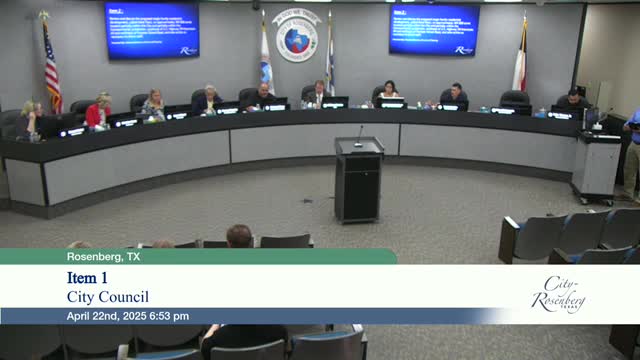
In the discussion the council did not take a final vote on an ordinance or development agreement; instead the council expressed a working consensus (reported during the meeting as roughly 4–2 among members present) to direct staff to work with the developer and the city attorney to finalize the proposed amendment to the Brookwater development agreement and to return to council with the written documents for formal action.
Mayor Benton asked staff and the city attorney to review the draft agreement and exhibits thoroughly and bring a refined item back for formal consideration.