Get Full Government Meeting Transcripts, Videos, & Alerts Forever!
Get email alerts on the Construction Contracts Bridge Painting topic
No spam. Unsubscribe anytime.
Judge allows expert addition, keeps MDOT's partial summary disposition under advisement in long-running bridge-painting case
Summary
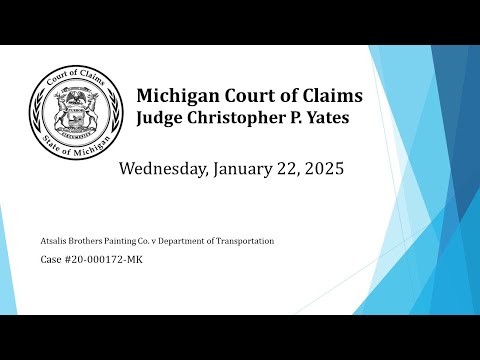
A judge in the Michigan Court of Claims granted Atsalas Brothers Painting Company leave to add a proposed expert witness and opened discovery for a deposition but did not decide the Michigan Department of Transportation's (MDOT) fifth motion for partial summary disposition, saying a written opinion will follow.
A judge in the Michigan Court of Claims granted Atsalas Brothers Painting Company leave to add a proposed expert witness and opened discovery for a deposition but did not decide the Michigan Department of Transportation's (MDOT) fifth motion for partial summary disposition, saying a written opinion will follow.
The ruling came in case no. 20-000172-MA, a construction dispute over bridge painting work on the Bluewater Bridge. The judge treated one discovery motion as withdrawn, granted the plaintiff's motion to add Greg Johnson as a proposed expert and allowed the defense to depose Johnson for up to seven hours and to name a rebuttal expert if needed. The court reserved ruling on MDOT's motion to dismiss parts of counts 2, 3 and 4 and said the judge will write a comprehensive opinion to explain what remains for trial.
The case concerns claims that MDOT improperly terminated the contract for convenience and disputes over required cleaning and coating work, including a contested blast-cleaning specification and allegations about the presence and scope of a Scotchcote (protective coating) material. The judge recited the procedural posture: the complaint was filed Aug. 27, 2020; the termination for convenience letter was dated March 31, 2020 and cited section 108.12 of the 01/08/2012 standard specifications for construction; and Atsalas's notice of intent to file a claim on the blast-cleaning issue was dated July 23, 2019.
Plaintiff's attorney Anthony Vitilio, representing Atsalas Brothers Painting Company, argued the contract did not require full, project-wide blast cleaning as MDOT contends and that the July 2019 written direction to —fully clean and coat— constituted the triggering circumstance giving rise to a claim. —We do believe there's no prejudice to the department by allowing us to add Mr. Johnson as a witness,— Vitilio said when the court signaled it would permit the expert addition.
Defense counsel John Tuttle, representing MDOT, told the judge that even if an expert were added, Johnson's testimony would not help resolve the remaining legal issues and reiterated MDOT's primary challenge: that Atsalas failed to give timely notice on portions of the differing site-condition and blast-cleaning claims. Tuttle argued prior rulings had already narrowed the case and that much of MDOT's motion rests on factual developments revealed during additional discovery.
On the expert motion, the judge said he was —inclined to grant— leave to add Greg Johnson but cautioned the ruling did not resolve admissibility under Michigan Rule of Evidence 702 or related Dawber standards. The court's practical direction: allow the defendant to depose Johnson for up to seven hours and permit pretrial motions to challenge admissibility.
The judge formally treated the plaintiff's October 18, 2024 motion to compel production (the first discovery motion addressed) as withdrawn and said he would enter a short order to that effect.
On MDOT's fifth motion for partial summary disposition, the central disputes concern (1) whether Atsalas's July 23, 2019 notice could reasonably be seen as untimely for work performed before that date, and (2) whether the Scotchcote/differing site-condition and misrepresentation claims are barred by contract notice rules or the economic loss doctrine and by inadequate damage records. The parties disputed whether the work performed before and after the July 2019 notice differed in kind or only in degree; the judge said discovery has since shown the work was performed under the same pay items and that, by some measures, Atsalas began main-span work in June 2019, before the written notice.
The judge declined to resolve the summary-disposition motion from the bench. He said he intends to write a comprehensive opinion to explain what remains for trial and why. The court also emphasized its gatekeeping role for expert testimony and the need for a record (deposition of the proposed expert) before deciding admissibility.
Practical figures discussed in the hearing: the contract award was about $8.3 million; progress payments to Atsalas exceeded $4 million; after audit and offsetting progress payments, the parties were —millions— apart, with MDOT's post-audit balance near $500,000 (figures were discussed in argument and referenced to the parties' filings and engineering accounts). The blast-cleaning pay item had been recorded at roughly 52% complete at the time MDOT terminated the contract; Atsalas's counsel said the company performed extensive work (including on the main span) prior to filing the July 23, 2019 notice.
The judge also discussed scheduling: counsel suggested a late-year or summer trial window, and the judge said he or a successor should have a clear road map from the written opinion to resolve remaining issues. He closed the hearing by saying he would issue a written opinion to guide further proceedings.
The record from today's hearing shows the court has (a) treated one discovery motion as withdrawn, (b) allowed an amended witness listing to add Greg Johnson as a proposed expert and opened discovery for his deposition, and (c) left MDOT's fifth motion for partial summary disposition under advisement pending a written opinion.