Get Full Government Meeting Transcripts, Videos, & Alerts Forever!
Get email alerts on the Local Government Budget Law topic
No spam. Unsubscribe anytime.
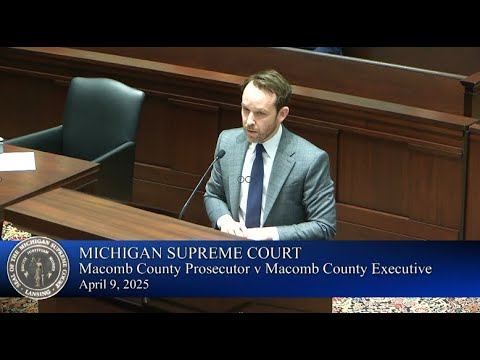
Michigan Supreme Court hears dispute over Macomb County charter, outside counsel and budget impoundment
Summary
At oral argument, attorneys for Macomb County and the Macomb County prosecutor disputed whether the county charter allows taxpayer funds to hire private outside counsel and when a prosecutor's challenge to an executive's impoundment of budgeted funds accrues under the Uniform Budgeting and Accounting Act.
At oral argument before the Michigan Supreme Court, attorneys for Macomb County and the Macomb County prosecutor clashed over whether the county charter permits the use of taxpayer funds to retain private law firms and when a prosecutor’s claim challenging an executive’s refusal to disperse budgeted funds begins to run under the Uniform Budgeting and Accounting Act.
The question matters because it bears on who can authorize and supervise legal work paid by the county and when a legal challenge to a county executive’s budget action becomes timely — issues that could affect how county governments handle legal representation and budget disputes across Michigan.
David Porter, attorney for Macomb County and County Executive Mark Hackle, urged the court to reverse the Court of Appeals. Porter told the justices the county prosecutor sought taxpayer funds to hire “five private law firms” as a parallel legal team and argued that the charter already requires countywide elected officials to receive general legal advice through corporation counsel or special counsel appointed by corporation counsel. He said the Court of Appeals’ reasoning — that the commission’s appropriation ordinance itself authorized the expenditures — would render the charter’s internal limits meaningless. Porter argued that under the charter’s text, corporation counsel has a duty to provide legal advice and that the commission cannot simply authorize outside counsel in a way that “sidelines corporation counsel” or makes the charter’s oversight provisions futile.
Porter also pressed a statute-of-limitations argument. He said the county executive “impounded the funds on Dec. 8, 2023” when the executive stated unequivocally that he would not allow the expenditure of the appropriation and that this public act started the 60‑day period for a budget enforcement action under the Uniform Budgeting and Accounting Act. Porter argued that allowing a challenge to be refiled each time contracts are re-presented would nullify the Act’s 60‑day window and lead to repeated litigation throughout a budget cycle. “He stated unequivocally that he would not allow the expenditure of these funds because they were unlawful under the charter,” Porter said.
John Perrin, attorney for the Macomb County Prosecutor, countered that a mere threatened veto is not an impoundment and that an impoundment requires the refusal to release funds after the appropriation process is complete. Perrin said the appropriation did not exist until the commission adopted the budget and that the veto-override process must run its course before an impoundment — and thus accrual — can occur. “An impoundment, by definition, is the refusal to release funds,” Perrin told the court. He described the back-and-forth between the executive and the commission as ordinary government negotiation and said the accrual question is not a matter requiring broad, statewide resolution because it turns on the particular charter language and drafting choices in Macomb County’s charter.
Perrin also urged a broader reading of “law” in the charter to include local ordinances and local acts. He pointed to charter provisions and state statutory lenses that, he said, permit county legislative action on local civil matters and argued the drafters intended a flexible, context-driven reading.
During argument the justices questioned how to read the charter’s internal limitations on expenditures for “legal counsel,” whether those limits apply only to countywide elected officials or also constrain the commission’s appropriation power, and how to apply accrual principles where officials continued to discuss contracts after the executive’s statements. Counsel for both sides acknowledged there was ongoing discussion between offices after the December statement, and the attorneys disagreed on whether those discussions affect the accrual rule.
The court took the case under submission at the close of argument. The justices did not issue a decision at the argument stage.
Additional details from the record: the dispute centers on a line-item veto the county executive issued on Dec. 8, 2023, after a general appropriations act the parties say was adopted in late November 2023; the prosecutor sought an appropriation to retain five private law firms; and the parties debated whether the relevant charter language — including provisions governing corporation counsel and limits on countywide elected officials’ expenditures for legal counsel — authorizes the commission to appropriate funds for outside counsel absent a statutory authorization.
The court's eventual ruling will determine how the Macomb County charter’s words “permitted by law” and its accrual rules for budget-enforcement suits are applied in practice, and could influence similar disputes in other Michigan counties.