Get Full Government Meeting Transcripts, Videos, & Alerts Forever!
Get email alerts on the Judicial Rulings Tax Foreclosure topic
No spam. Unsubscribe anytime.
Michigan Supreme Court hears arguments in Yono v. Ingham County over tax-foreclosure surplus proceeds
Summary
At oral argument, counsel for Ingham County told the court that no surplus proceeds arose from an unsuccessful tax-foreclosure sale and thus no compensation is owed, while the property owner’s attorney argued the taking effectively seized equity and that the statute and precedent require a valuation analysis.
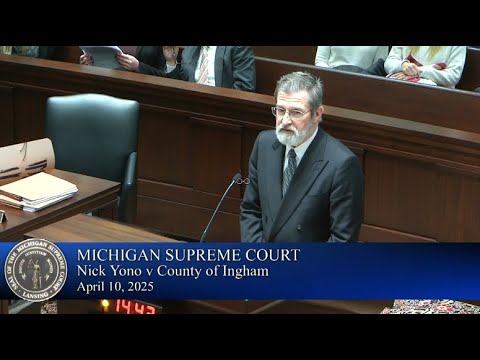
Lansing — The Michigan Supreme Court heard oral argument in Yono v. County of Ingham on whether a taxpayer is entitled to compensation for equity in property that a county acquired after an unsuccessful tax-foreclosure sale, attorneys told the court. Counsel for Ingham County said the court of appeals’ decision should be reversed because no surplus proceeds arose; the property did not sell at auction and the county took title. The taxpayer’s attorney urged the court to require a valuation determination and said the government’s acquisition effectively took more than necessary to satisfy the tax debt.
The issue arises under Michigan tax-foreclosure law, principally MCL 211.78m, and the parties debated how state precedent — described in argument as Rafaeli — and more recent federal authority such as Tyler factor into whether a property owner may recover compensation when the foreclosing governmental unit retains title after a failed sale.
Douglas Curlo, arguing for the Ingham County Treasurer, Ingham County and the Ingham County Land Bank, told the court this case is “the precise case that was warned about in Rafaeli” and that, because the county attempted to sell the property and the market showed no buyer, “there can be no basis for compensation.” Curlo said the case involves only Michigan law and noted there were no federal constitutional takings claims raised in the lower courts. He also argued that allowing recovery where the property failed to sell would improperly transfer public funds “for the benefit of the delinquent.”
Kevin Schumacher, representing the plaintiff Appelli Yono, responded that the record shows the county listed the parcel as being held “for potential redevelopment of Old Town in Lansing,” and argued that government actions inconsistent with treating the parcel as a simple fire-sale justify compensation. Schumacher said the statute gives the state and then local governments rights of first refusal under different valuation rules and argued that taxpayers are the least protected participants in the foreclosure process: “If you have a $17,000 debt, why do you have to seize all $378,000 worth of property?” he asked, referencing figures he attributed to the record and county tax statements.
Justices questioned both sides about redemption rights, the effect of a sale at the minimum bid, and whether an auction’s failure to produce bidders is the best test of market value. One justice noted that if a property sells at the minimum bid, “there's nothing…the surplus proceeds is 0.” Counsel for Yono disputed that the auction result should be dispositive where the government retained the property and urged a remand for a valuation determination at the time of taking. County counsel told the court that requiring second-guessing of every sale effort would open a “floodgate” of litigation and reiterated that the county attempted to sell and that no surplus proceeds arose.
At the close of argument, the court announced the case was submitted for decision. The transcript shows the parties debated whether the applicable statutes require the court or a lower court to determine fair market value when a foreclosing governmental unit retains title after an unsuccessful sale, and whether Rafaeli and cited federal authority limit recovery to surplus proceeds.