Get Full Government Meeting Transcripts, Videos, & Alerts Forever!
Get email alerts on the Transportation Access topic
No spam. Unsubscribe anytime.
Committee narrows e‑bike rebate to low/moderate‑income Minnesotans and people with disabilities
Summary
Senate bill revises the state's e‑bike rebate program to target low‑ and moderate‑income households and people with disabilities, reduce the rebate amount, use a lottery system, and require tax‑return proof; supporters say limited remaining funds will be better targeted.
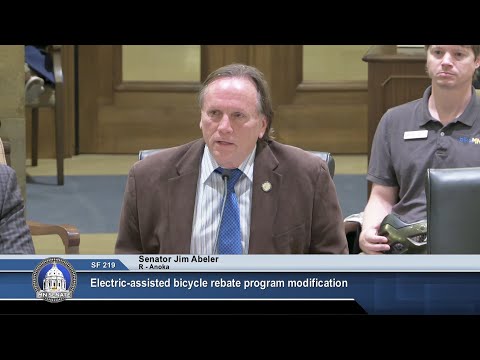
Senator Andrew Abler presented an amendment to reform Minnesota's e‑bike rebate program, shifting it from a broad first‑come, first‑served model to a targeted approach that prioritizes low‑ and moderate‑income residents and people with disabilities.
The A5 amendment adopted by the committee changes eligibility and administration: it reduces the maximum rebate from $1,500 to $750, establishes priority for households with lower incomes and for people with disabilities, codifies a lottery selection process, and clarifies that winners must have filed the required tax returns. The sponsor said the changes are designed to stretch remaining program dollars to benefit people who rely on e‑bikes for transportation rather than recreation.
"This will give up to around 3,000 people with a disability the chance to buy an e‑bike," Abler said, describing the program as a mobility tool. He told senators $1,500 proved excessive and that $750 is an appropriate market subsidy.
Michael Wojciech, executive director of the Bicycle Alliance of Minnesota, testified in support and described strong demand when the earlier program opened: "More than 1% of Minnesotans were online trying to get the rebate...it was gone in a matter of seconds," he said. He added the program helps households without vehicles and those in Greater Minnesota lacking fixed‑route transit.
Committee members asked how to define "person with a disability" in statutory language. Revenue staff and committee counsel said the amendment does not currently define the term and that the committee intends to work with the Department of Revenue and look at definitions other states use before finalizing language. Senator Abler said the bill preserves existing funding (no new appropriation) and would use roughly $2.5 million remaining in the program to target about 3,000 recipients.
The A5 amendment was adopted by voice vote and the bill as amended was laid over; committee members asked for follow‑up language clarifying the disability definition and implementation details.