Get Full Government Meeting Transcripts, Videos, & Alerts Forever!
Get email alerts on the Housing topic
No spam. Unsubscribe anytime.
San Mateo council directs staff to draft tenant-protection measures, defers rental registry
Summary
After a lengthy study session and more than an hour of public comment, the City Council instructed staff to draft ordinances implementing parts of the certified housing element aimed at reducing displacement, directed work on emergency rental assistance and enforcement changes, and decided against creating a citywide rent registry for now.
The San Mateo City Council on Monday directed staff to draft ordinances implementing portions of the city’s certified 2023–2031 housing element aimed at protecting tenants from displacement, while declining to adopt a citywide rental registry at this time.
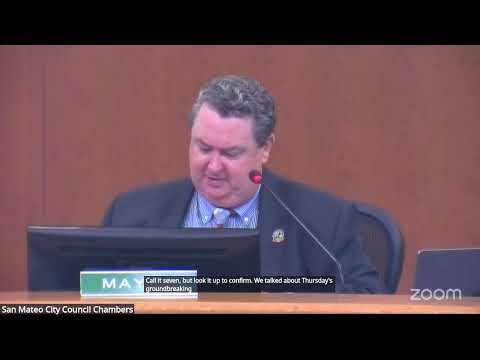
The direction came after a staff presentation by Rachel Horst, housing and neighborhood services manager, and Jennifer Mora, housing specialist, a multi-hour public comment period and council discussion during a study-session item on housing element implementation and anti-displacement measures.
Staff framed the discussion around several housing-element commitments: expanding relocation assistance, a right-to-return following demolition or substantial remodels, strengthening enforcement for tenants displaced by unsafe or substandard housing, and researching options for a rental registry to better track rents and evictions. Horst told the council that “rent control is not 1 of those considerations this evening.”
Public commenters and organized groups were split. Representatives of the Our Home San Mateo coalition, the Housing Leadership Council and faith-based groups urged stronger tenant protections; Theresa Gebler said the community “really cares about renters issues.” Trade and landlord groups, including the California Apartment Association and the San Mateo County Association of Realtors, warned that additional regulation could increase costs for small “mom-and-pop” owners and reduce housing supply; Mitch Spiegel of the Realtors group said, “Supply solves this issue, Only supply.”
Council directions and next steps
- Relocation assistance: Council directed staff to prepare an ordinance extending relocation protections described in the housing element to tenants with tenure under 12 months, with the council’s working threshold set at 11 months. At the meeting the mayor summarized a majority direction to bring back an ordinance with that threshold. At the same time councilmembers signaled different views about the immediate dollar amount; the mayor noted a working summary that initial implementation would proceed with one month of relocation assistance while staff prepares ordinance language and impact analysis and returns to council.
- Right to return after substantial remodel/demolition: Council members agreed staff should include a notice-and-right-to-apply provision for tenants displaced by demolition or substantial rehab; the council requested the right to return be implemented at the re‑let (post‑rehab) market rate rather than holding the returning tenant to the pre‑displacement rent.
- Enforcement and temporary relocation payments: Council asked staff to strengthen the city’s enforcement and penalty structure for code‑enforcement displacements and to explore calculating temporary relocation payments using actual costs for up to 90 days rather than tying payments strictly to HUD fair‑market rent formulas.
- Rental registry: A majority of the council declined to adopt a citywide rental registry at this time, directing staff instead to refine and use existing data sources (business license records, commercial rental databases and regional data partnerships) and to return in roughly one year with a reassessment. Staff noted examples and costs from other Bay Area cities and cautioned that setup and staffing costs vary widely.
- Emergency rental assistance and priorities: Council directed staff to return with a proposal for an emergency rental‑assistance program (staff identified potential funding sources including the affordable housing fund and an initial budget figure in the low hundreds of thousands of dollars for study and administration). Councilmembers also asked staff to prioritize education/outreach to tenants and landlords and to explore a hearing‑officer model for disputes related to unsafe/substandard housing enforcement.
No ordinance was adopted at the meeting; the item was a study session and the council’s decisions functioned as direction to staff to draft ordinance language, cost estimates and an implementation plan for return to council. Council members said they expect staff to return with ordinance language and budget information and to report back within a year on initial outcomes.
Why this matters
San Mateo’s housing element commits the city to anti‑displacement measures as it meets regional housing goals. Council direction to draft specific code language and to pursue emergency assistance and stronger enforcement represents the city’s next step from policy toward actionable rules and programs. At the same time, the council’s decision to pause on a rental registry reflects council concern about start‑up costs and staffing burdens and a preference to pursue lower‑cost data options in the short term.
Speakers quoted or referenced in this article are those who took part in the discussion and public comment at the study session. The council’s direction was not a final legislative action; ordinances implementing the agreed changes will return to the council for formal consideration and vote.