Get Full Government Meeting Transcripts, Videos, & Alerts Forever!
Get email alerts on the Housing Policy topic
No spam. Unsubscribe anytime.
Santa Barbara staff brief council on housing bond, builder's remedy protections and Brown Act changes
Summary
City officials and outside lobbyists reviewed a slate of state bills affecting housing finance, permit streamlining, encampment funding, wildfire resilience and public-meeting rules. Presenters recommended support, oppose-unless-amended, or monitoring positions on specific bills; no formal city votes were taken at the briefing.
City of Santa Barbara staff and outside lobbyists briefed city officials on a wide set of California bills on Oct. 26, 2025, highlighting proposed housing bonds, changes to housing-element enforcement and builder's remedy protections, homelessness and encampment funding, wildfire-resilience grants tied to insurance revenues, and proposals to modernize the Brown Act for remote public participation.
The briefing matters because the bills discussed shape which projects and programs will be eligible for state funding, how quickly housing projects can move through local review, and how local governments must conduct and translate public meetings. Presenters advised the city to adopt support, oppose-unless-amended, or monitoring positions on several measures but did not bring any motions for formal action during the session.
Townsend Group lobbyist Carly (Townsend lobbyist) opened the session by outlining the city's legislative platform and explaining the two-year nature of the 2025 legislative session, saying, "This is the first year of a 2 year session." She and colleagues recommended positions on a subset of bills while flagging a broader package for monitoring.
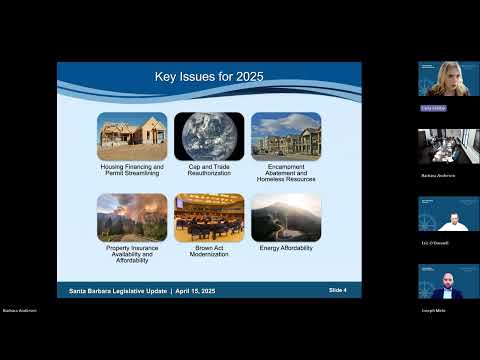
Housing and housing finance dominated the presentation. Townsend staff described two competing $10 billion general-obligation housing bond proposals (assembly and senate versions) that could be consolidated; the presenters recommended supporting a bond if it were amended to add money for the State's local housing trust fund. Carly summarized the bond's typical program allocations: the multifamily housing program would receive the largest share, roughly two-thirds of bond dollars; other proposed allocations discussed in the briefing included about $1 billion for down-payment assistance through CalHFA, $250 million for farmworker housing, $400 million for infill infrastructure, and roughly $1 billion for portfolio reinvestment programs. Presenters emphasized that most bond funds flow to statewide HCD-administered programs and are awarded to developers or program administrators rather than directly to cities.
Townsend recommended support for two housing-element bills intended to limit misuse of the builder's remedy and increase clarity and timelines with the Department of Housing and Community Development (HCD). The presentation described AB 650 as a bill to standardize HCD determinations and add a six-month timeline and penalty protections while jurisdictions make corrections; SB 457 was presented as a complementary measure that would protect cities from the builder's remedy during the certification gap and require builder's-remedy applications to be complete.
Presenters also flagged a broad permit-streamlining package championed by Assemblymember Wicks and warned that some proposals could raise local liability or reduce local review. One example called out was AB 712'style amendments that would increase penalties and could create attorney-fee exposure for local governments; Townsend staff said they are actively engaging with bill authors and monitoring amendments.
On homelessness and encampments, Townsend recommended support for Senate Bill 569 to increase Caltrans coordination with local governments and create district-level liaison and joint-action plans, and for Senate Bill 748 to allow Encampment Resolution grant funds to be used for acquiring property for safe-parking sites and vehicle/RV abatement.
Wildfire resilience and insurance also drew substantial attention. Townsend described AB 888 as a proposal to create a new grant program funded in part by insurance premium tax revenue to support home hardening and community mitigation. SB 616 was presented as creating a new advisory structure within the insurance commission to recommend community hardening standards and spending priorities. Presenters described these bills as significant and evolving.
On building codes, Townsend said the office has an opposing-unless-amended position on AB 306, which would institute a broad moratorium on local building-code amendments for new residential standards through 2033. Presenters and council members warned that a multi-year moratorium could block local reach codes and local climate or energy measures unless the bill is amended to allow the 2025 model code changes to proceed.
Presenters recommended support for SB 346, which would provide cities with assessor parcel numbers for short-term rentals and additional audit authority over transient-occupancy-tax remittances, and support for SB 456 to exempt muralists from contractors'licensing rules so municipalities can continue to fund public artists.
Brown Act modernization was presented as an active and unresolved item. Townsend explained two parallel approaches: an Assembly plan that would remove the sunset on AB 2449-era remote-meeting flexibilities and a Senate bill (SB 707) that aims for broader, more prescriptive modernization. Townsend warned that SB 707, as drafted, would require two-way audiovisual participation at all city council meetings and expanded agenda translation and interpretation duties based on countywide language thresholds, a change that could increase compliance costs. A Townsend presenter said the Senate'authored proposal "is going to be a big change" and that authors still have not resolved solutions for security risks such as "Zoom bombing." The group recommended supporting the Assembly approach to simply preserve current flexibilities while monitoring the Senate process.
Public commenters urged stronger emphasis on subsidized affordable housing and cautioned against measures that would erode local review. Resident Lisa Carlos asked the city to press Sacramento for funds targeted to low- and very-low-income households and said, "We can't deregulate by over legislating. We can't streamline by micromanaging." Rob Fredericks of the Housing Authority of the City of Santa Barbara supported bond funding that replenishes the local housing trust fund and listed several state bills the authority supports, including AB 282 (source-of-income protections) and SB 336 (low-income housing tax-credit swaps). Other members of the public urged opposition to bills that would remove Coastal Commission review or override CEQA and local planning tools.
The briefing included no formal committee votes. Presenters said letters and earlier positions the city has taken are on file and can be linked to the city's shared drive or posted for transparency. Staff said they will return with follow-up analysis, identify the highest-priority bills for the city to influence, and schedule further meetings as bills evolve toward policy and appropriations deadlines.
For now, the immediate calendar items to watch are the governor's May revise and key policy deadlines in Sacramento that will determine which bills advance and how bond proposals and budget actions may change in coming weeks.