
Roseburg budget committee pauses adoption amid uncertain state, federal revenues; elects chair and vice chair
Get AI-powered insights, summaries, and transcripts
Sign Up Free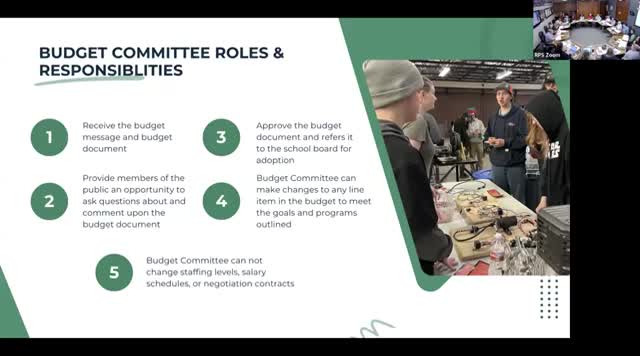
Summary
At a Roseburg School District Budget Committee meeting, Superintendent Jared Cordon delivered the budget message and staff outlined an estimated $6 million shortfall for the coming year driven largely by PERS liability adjustments and uncertainty in federal forest and other federal funds.
At a Roseburg School District Budget Committee meeting, Superintendent Jared Cordon delivered the budget message and staff outlined an estimated $6 million shortfall for the coming year driven largely by PERS liability adjustments and uncertainty in federal forest and other federal funds. Committee members nominated and approved Mike Schofield as committee chair and Mia Murphy as vice chair, discussed proposed one-time transfers from reserve funds and deferred transfers to cover the gap, and recessed without adopting the budget pending further review.
Cordon told the committee the proposed budget is aligned to the district strategic plan and “built and designed and centered on kids.” He stressed the unusual level of uncertainty this season: the district has not yet received reliable federal funding estimates for some programs and is working against changing state biennium figures. He and staff described a roughly $6 million gap under the state’s current 11.36 billion biennium estimate, and identified three primary bridges to reduce that shortfall: about $2.4 million in direct reductions, roughly $2.5 million from savings, and approximately $1.1 million from reduced internal transfers.
Budget staff described several specific drivers. District officials said a PERS actuarial change will reduce district resources by about $4.3 million. The Secure Rural Schools federal payments that usually support local schools and county services were not reauthorized on schedule; staff said a retroactive payment is expected but the amount and timing were not fully specified (estimates discussed in the meeting ranged from roughly $650,000 to about $1 million). The superintendent and business staff also cited contractual obligations, insurance increases, and modest enrollment declines as contributors to the projected gap.
Danielle Littlefield, the district’s account/budget manager, reviewed the roles of the budget committee and then walked members through revenue and transfer assumptions. “The budget committee approves the budget document and refers it to the school board for adoption,” Littlefield said, and she repeated that the committee may adjust line items but cannot change negotiated staffing levels. Staff explained the district budgets some beginning fund balance to smooth cash flow and noted that several internal transfers—tech, vehicle replacement, field replacement and major maintenance—were reduced in the proposed plan. Staff identified a $2.0 million current-year transfer budgeted to the Advanced Medical Pathway project in the district’s 404 fund and a separate $2.5 million seismic project budgeted in the 400 fund for RHS.
Committee members asked whether the proposed reductions included layoffs. Staff said that to date reductions have come through attrition and other restructurings rather than involuntary teacher layoffs, and that administrators sought to protect classroom positions where possible. Cordon said the district had reduced some administrative positions and that the budget team tried to avoid cuts that would directly affect students and classrooms.
The meeting also included discussion of capital priorities and community engagement. Cordon described a board-directed $2.5 million investment to develop an Advanced Medical Pathway building on the college campus (UCC) and said the district hopes it will be the first high school building on a college campus in Oregon. The long-standing condition of Old Main on the high school campus drew questions from members; Cordon said the building “turns a hundred next year” and that the district will continue community conversations about reuse, rehabilitation or replacement. Several committee and board members discussed messaging and community vision as central to future bond or levy efforts, and noted that pathways and CTE programs have high graduation outcomes and can be used in public outreach.
On procedural items the committee elected leadership and set next steps. Members nominated Mike Schofield for budget committee chair; the motion carried by voice vote. A nomination for Mia Murphy as vice chair also carried by voice vote. Committee members did not adopt the budget at the meeting; instead the committee recessed to a later scheduled meeting (members referenced the next meeting date as the 23rd) and asked staff to accept written questions and provide follow-up detail before formal adoption.
What was not decided: the committee did not finalize appropriations or adopt the budget document at this meeting. Staff said they are planning scenarios for a range of funding outcomes and will return to the committee if state or federal numbers change. Officials repeatedly cautioned the committee that several revenue items remain estimates and that any additional legislative or federal action could require changes to the adopted budget.
The committee’s next steps include written follow-up from staff in response to member questions, review of the budget document in advance of the next meeting, and reconvening for possible adoption or further adjustment once revenue estimates are firmer.