Get Full Government Meeting Transcripts, Videos, & Alerts Forever!
Get email alerts on the Parks Recreation topic
No spam. Unsubscribe anytime.
Consultants present parks and recreation strategic plan; recommend staffing, funding increases, and facility priorities
Summary
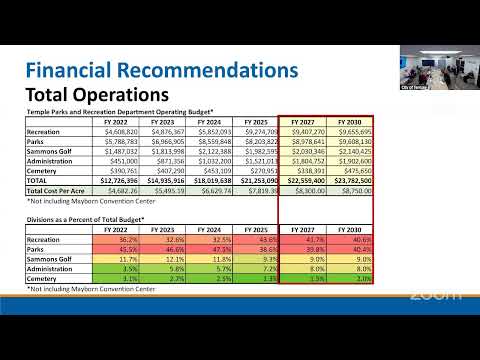
Consultants presented a 13‑month parks and recreation strategic planning process recommending staffing changes, prioritized investments (farmers market, trails, dog park), a probable indoor field‑house, and an operations/maintenance funding increase toward a $24 million annual run rate and roughly $4,500 per‑acre maintenance target by 2030.
The City of Temple received a presentation of a parks and recreation strategic plan developed over about 13 months with public and staff engagement, a statistically valid mailed household survey and an internal staff cohort.
Consultants summarized key findings from a mailed, statistically valid survey that produced 365 responses (a reported margin of error of about ±5.2 percent). Major survey findings included strong use of Lions Park, Crossroads Park and Miller Park; high program participation (52 percent of respondents said a household member participated in two or three programs or events in the previous 12 months); and top facility and program priorities such as a farmers market, multi‑use paved trails, and a dog park. Consultants said arts and culture, senior fitness and adult wellness programs also emerged as priorities.
Recommendations included: - Developing an actionable cost‑recovery and pricing framework that distinguishes essential public services from value‑added offerings; consultants said many communities target overall parks and recreation cost‑recovery in the 50–60 percent range but emphasized community context matters. - Phasing investments that reduce environmental impacts, including selective conversion of some natural turf to artificial turf for high‑use fields to conserve water and increase usable hours. - Considering an additional indoor recreation facility (field house) to meet demand for indoor multipurpose recreation space. - Increasing parks maintenance funding from the current reported figure (about $3,847 per acre) toward approximately $4,500 per acre, phased to 2030; consultants estimated that achieving the recommended per‑acre maintenance target would require roughly $1.7 million more in annual maintenance funding by 2030 compared with 2024 levels. - Strengthening staffing and organizational structure, including a parks division director, additional mid‑level supervisors (crew leaders), a volunteer coordinator, more communications/marketing capacity, and a potential reorganization on the recreation side to move from facility‑based program creation toward systemwide program leads.
Consultants said the city has invested about $80 million (inflation‑adjusted) in parks and recreation capital over the last 30 years, with Crossroads Park representing about 30 percent of that total. They also recommended prioritizing preventative maintenance and alignment of future master‑planning work with the strategic plan’s organizational recommendations.
Elected officials and staff asked clarifying questions about trail connectivity, program counts (consultants reported roughly 154 programs), translation and bilingual outreach, and possible funding approaches including bonds or partnerships. Staff said the plan will support the parks department’s accreditation efforts and provide a framework for upcoming master‑plan work, cost‑recovery policy development and budgeting discussions. No formal council action or commitments of new funding were made in the session; staff and council discussed next steps for implementation and potential timing of master‑plan work and budget adjustments.