Get Full Government Meeting Transcripts, Videos, & Alerts Forever!
Get email alerts on the Zoning Code Update topic
No spam. Unsubscribe anytime.
County staff outlines 2026 Chapter 17 zoning-code update; towns asked for input on accessory uses, signs and contractor uses
Summary
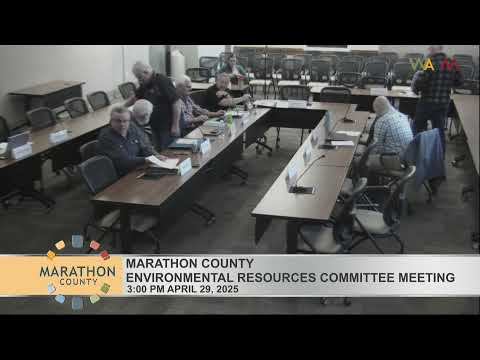
Marathon County CPZ staff told the Environmental Resource Committee April 29 they are preparing a comprehensive 2026 update to Chapter 17 (zoning), soliciting town input and planning amendments for contractor/home-business uses, accessory-structure sizes, fences, signs and special-event consistency.
County CPZ staff told the Environmental Resource Committee on April 29 that work is underway to comprehensively update Marathon County Chapter 17 zoning code in 2026 and that the county had surveyed townships to collect input on priorities for ordinance amendments.
Survey results and town feedback
Staff said they had sent surveys to town clerks and early responses from participating towns indicate most feel Chapter 17 aligns with their development goals and that they intend to remain in county zoning. Of the surveys received to date (staff said results were incomplete at the time of the ERC briefing) common town requests included clearer guidance on county processes, short "cheat sheets" for district standards, better communications on grants and collaboration, and—in some cases—requests for stricter wind and solar setbacks (staff noted statutory limits on what counties can regulate in that area).
Potential zoning-code amendments under study
Staff identified specific areas for amendment that will be developed over the coming months: (1) a defined "contractor use" or small-scale accessory business category to more easily allow contractors or mobile-business storage at residences without pursuing conditional-use procedures, (2) clearer special-event provisions to reference an updated large-assembly licensing ordinance (12-04) and ensure consistency, (3) possible increases in accessory-structure maximum sizes in residential districts, (4) simplified and clarified fence regulations and possible increases to allowed fence height (requests for 8-foot residential privacy fences were noted), and (5) sign regulation updates to improve visibility and allow larger signs on local roads while maintaining safety on state roads (statutory setbacks for state highways would remain). Staff also noted the need to update cross-references after separating shoreland and floodplain ordinance language into distinct codes.
Process and timeline
CPZ laid out a timeline for the comprehensive update: town surveys in February, further ERC discussions from May through August, draft amendments circulated to towns for comment in September–October, final modifications in November and a planned December ERC package to forward to the County Board in time for a 2026 effective date. Staff cautioned that when towns adopt the revised county zoning code they must sign up under the new code within a year, and staff will assist towns with information during the transition.
Next steps
Staff will continue to collect town responses, develop draft ordinance language for the identified topics, coordinate with highway and other departments on sign and setback questions, and return to ERC with draft amendments for review.