Get Full Government Meeting Transcripts, Videos, & Alerts Forever!
Get email alerts on the Leachate Pfas Treatment topic
No spam. Unsubscribe anytime.
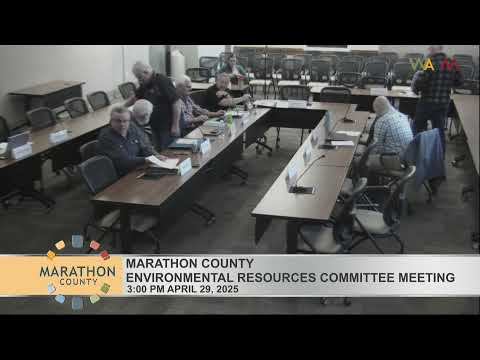
Solid-waste director outlines $12 million reverse-osmosis plan to treat PFAS in landfill leachate; committee briefed on funding options
Summary
Marathon County solid-waste staff described PFAS in landfill leachate, treatment challenges and a proposed on-site reverse-osmosis facility estimated at $12 million for regional capacity; staff said they will pursue Clean Water Fund and other funding but no final county decision was made.
Marathon County Solid Waste staff presented the Environmental Resource Committee an extensive briefing on PFAS in landfill leachate, treatment alternatives and a preliminary plan to build a reverse‑osmosis (RO) treatment facility at the county landfill to manage current and anticipated leachate volumes.
Why the issue matters
Staff explained that PFAS (per- and polyfluoroalkyl substances) accumulate in landfill leachate from everyday consumer products and present a disposal challenge because many wastewater treatment plants are reluctant to accept PFAS-laden leachate due to effluent limits, biosolids concerns and potential future liabilities. The county currently hauls leachate off-site to nearby treatment plants under volume limits (four loads per day to Plover, two to Stevens Point). That off-site hauling approaches operational limits and costs roughly $1 million per year.
Proposed on-site solution and rationale
Solid-waste staff outlined alternatives they evaluated—reverse osmosis, ion exchange, granular activated carbon and foam fractionation—and described RO as the preferred long-term option because it can treat on-site and produce an effluent suitable for infiltration while consolidating residuals for landfill disposal. Staff presented a conceptual regional RO facility sized for roughly 100,000 gallons per day with equalization storage to smooth peak flows. The capital estimate for a regional-scale RO system was presented at about $12,000,000; Marathon-only capacity would be lower but still multi-million-dollar.
Funding pathways and next steps
Staff said the county has applied for a Clean Water Fund (state revolving fund) environmental loan and indicated possible principal forgiveness of up to $2 million targeted to emerging-contaminant projects. Other funding avenues discussed included federal or state grants, Innovation Program funds and potential royalty revenue from the county’s renewable natural gas effort to offset costs. Staff recommended pursuing available grant and loan options now while funding is allocated for emerging contaminants.
Regional collaboration and regulatory context
Staff emphasized the regional nature of the problem—neighboring counties and closed landfills share similar PFAS leachate issues—and said the county is discussing partnerships with nearby counties that currently use the Marathon landfill. Staff also noted they participate in DNR advisory groups on PFAS and that EPA guidance on biosolids (1 ppb screening reference mentioned in briefing) increases pressure on wastewater and landfill actors to address PFAS management comprehensively.
Committee questions and operational details
Supervisors asked about treatment capacity assumptions, peak flow planning (staff estimated Marathon generates ~30,000 gallons/day on average with spring peaks to 60–70,000), staffing needs (staff suggested three dedicated operators), and potential business models to recover costs if the county were to operate regionally. Staff said the facility would require equalization tanks (100,000–150,000 gallons) and that a regional business plan would need to identify likely customers, tipping-fee terms and whether external loads would be added to a tipping-fee structure.
Outcome and timeline
No final capital commitment was made. Staff said the Clean Water Fund application process requires a public comment period (May) and a public hearing (June) and that the County Board would need to approve a resolution to submit an application; if funded, construction could begin in 2026–27. Staff urged the committee to treat PFAS leachate treatment as a systemic regional problem and to consider financing and partnership options to spread costs across beneficiaries.