Get Full Government Meeting Transcripts, Videos, & Alerts Forever!
Get email alerts on the Domestic Violence Lgbtq topic
No spam. Unsubscribe anytime.
Prince George's County workgroup compiles recommendations to improve domestic‑violence services for LGBTQ+ residents
Summary
A Prince George's County Council LGBTQIA+ workgroup reviewed a set of recommendations to address gaps in first‑responder training, shelter access, hotlines, legal help and mental‑health services for LGBTQ+ survivors of domestic violence and agreed to collect further information and vote on final recommendations at a later date.
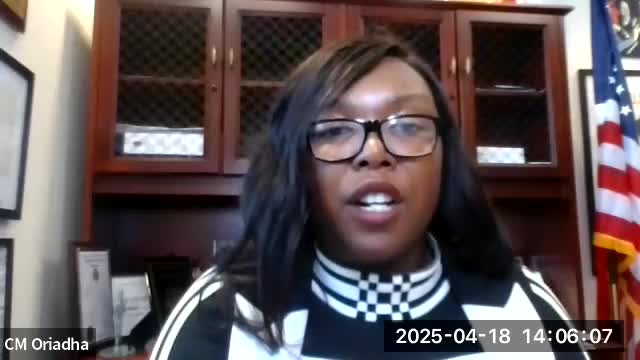
Prince George's County Council Vice Chair and LGBTQIA+ Workgroup Co‑Chair Crystal Orieva opened the meeting by saying the group would focus on “specific recommendations around domestic violence and the intersection with LGBTQ plus community and how we can better serve the community from that lens.”
The workgroup spent the session reviewing a package of recommendations aimed at improving county response to domestic violence affecting LGBTQ+ residents. Members discussed short‑ and mid‑term steps including mandatory cultural‑competency training for first responders, designated affirming shelter beds, expanded outreach at LGBTQ venues (including coordination with events in nearby Washington, D.C.), inclusive hotline services, free or low‑cost legal clinics, a peer survivor advocacy program, mobile outreach, expanded trauma‑informed mental‑health access, emergency phones and transit cards, youth prevention workshops, and a countywide multilingual resource guide.
The workgroup did take a formal procedural step at the start of the meeting: a workgroup member moved to approve the March 21 meeting minutes and the motion was seconded by Vice Chair Crystal Orieva. Hearing no objections, the minutes were approved by consensus.
Members framed the recommendations with timelines and rough cost expectations discussed during the meeting: short‑term items (roughly three to six months) such as resource cards, emergency phones and transit cards, and outreach at events; mid‑term items (six to 12 months) such as designated shelter beds, youth prevention workshops, and a county resource guide; and longer or mid‑to‑longer projects such as expanding trauma‑informed therapy access and establishing a peer survivor advocacy program. Several proposals were described as having moderate to high cost depending on whether the county would reallocate existing resources or create new, dedicated programs.
Participants identified local organizations and programs to consult or partner with as the workgroup develops recommendations. A community advisory board member for Progressing Life in the Community (formerly Progressive Life Center) said community providers are developing relevant trainings and “there are organizations... who would potentially be able to partner” on wider rollout. A representative from the Office of Human Rights noted existing collaborations between the Office and the Department of Family Services on healthy‑dating programming for teens and suggested that the workgroup could expand that model to include LGBTQ‑specific language and examples.
On training, members discussed two layers: (1) short, focused cultural‑competency or red‑flag training for all first responders and shelter intake staff; and (2) a long‑term goal of integrating LGBTQ+ domestic‑violence content into academy or continuing‑education requirements so the training is not optional. The group named resources to consult, including Progressing Life in the Community, the Maryland Coalition Against Sexual Assault, and trainings on gender‑affirming SANE (sexual assault nurse examiner) care.
On shelter access, members noted that existing shelters are expected to be welcoming but lack designated LGBTQ+ affirming beds or staff with consistent training. The workgroup discussed requiring shelters to adopt nondiscrimination policies and staff training so transgender and nonbinary residents are not misgendered or denied services, and considered whether curated or designated spaces might be necessary for some survivors to feel secure.
Participants raised outreach and access items likely to increase help‑seeking by LGBTQ+ survivors: mobile outreach and tabling at LGBTQ‑oriented events (including partnering with venues in Washington, D.C.), inclusive hotline services that use gender‑affirming language and collect intake data that identifies callers' needs, free legal clinics for domestic‑violence and discrimination issues, and a single multilingual resource guide with QR codes linking to county and provider resources.
Members discussed gaps in mental‑health services for long‑term care. A workgroup participant noted limited provider capacity and insurance‑related barriers — including credentialing burdens and low reimbursement rates that discourage providers from accepting public insurance — and said the county’s behavioral health authority and Crisis Intervention Center staff would be appropriate contacts for planning expansions.
The workgroup asked staff to follow up on the named examples and report back with details for each recommendation, including potential partner organizations, funding sources (grant or county funds), and draft language for policy or program requirements. The group will collect final recommendations and vote on them at a future meeting; the co‑chair reminded members that the next scheduled meeting is May 16 at 2 p.m.
Ending: The meeting closed with the workgroup agreeing to continue collecting recommendations and to prepare a final report for presentation to the County Council and the County Executive; members were encouraged to submit any additional recommendations to be included in that report.