Get Full Government Meeting Transcripts, Videos, & Alerts Forever!
Get email alerts on the Utility Rates topic
No spam. Unsubscribe anytime.
Miami consultant urges 3-year electric rate plan to fund $28 million in system upgrades
Summary
A financial consultant told the City of Miami the utility must raise rates over three years to cover GRDA purchase-power increases, fund $28 million in capital improvements and maintain service; staff also proposed a higher charge for customer-owned generation systems such as rooftop solar.
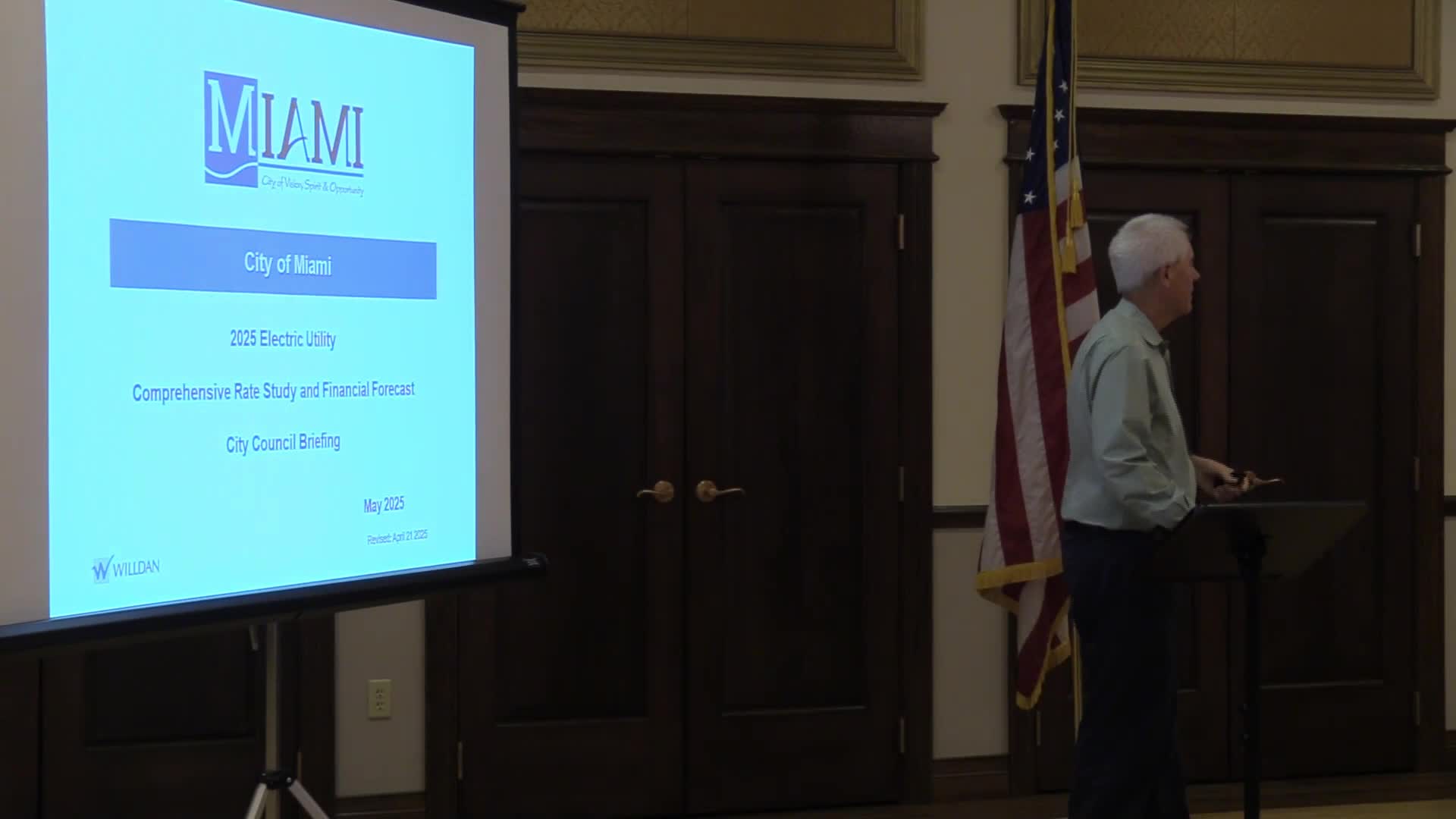
David Jackson, vice president of William Financial Services, told the City of Miami council and utility board that the city needs a three-year electric rate plan to cover rising purchase-power costs, fund $28 million in capital work and make room for a partial customer share of an Advanced Metering Infrastructure (AMI) grant.
Jackson said the recommendation is driven by four factors: inflation, higher wholesale power charges from the Grand River Dam Authority (GRDA), planned debt for capital improvements and the city’s portion of an AMI grant. “There are 4 factors more than anything else that are driving the need for a new rate plan,” Jackson said during his presentation. He added that GRDA is implementing an 11% rate increase in the current year and 4% increases in 2026 and 2027.
The consultant summarized the proposed schedule and customer impact. Under the plan, non‑GRDA costs would increase 12% in mid‑2025, followed Jan. 2026 by a $4 rise in the residential base charge plus a 5% increase in volumetric (per‑kWh) charges, and another 5% volumetric increase in Jan. 2027. Jackson gave example impacts: the average Miami residential customer — about 860–865 kWh monthly and currently paying roughly $111 — would see a roughly $8.91 increase in June 2025, about another $9 in Jan. 2026 and about $6 in Jan. 2027. Jackson said these changes would allow the utility to cover a roughly $3 million annual transfer to the general fund and to fund about $28 million in system investments.
Why it matters: Jackson framed the increases as partly unavoidable pass‑throughs of GRDA’s higher costs and partly a means to maintain system reliability. “If you are selling any of your customers at less than what you are paying to produce it, then that’s not good business,” he said. He also noted a forecast that total cost of service is roughly $24 million now and is expected to rise to about $27 million over the next three years.
Planned projects and financing: Jackson said the $28 million of proposed debt would be issued in stages, with many borrowings expected in the next two years, to pay for distribution reconductoring, pole replacements, feeder upgrades, Substation 3 improvements and development of a solar farm, and to support the AMI rollout. He recommended phasing rate increases to match the staged borrowing.
Customer‑owned generation (solar) charge: Utility staff presented a separate but related request to change how the city bills customers who own on‑site generation (solar or other customer‑owned systems). Katie Pruitt, executive assistant to the utility superintendent, said the staff is “requesting a rate increase on customer‑owned generation systems,” and described the intent as recovering the utility’s fixed costs for maintaining the distribution system that backstops customer generation.
Staff outlined recent storm repair costs and asset values to justify the change. Michael Robertson, identified as lead lineman, and Jake Gibbs discussed material and labor costs: Robertson said the utility has about 7,000 poles (roughly $500 per pole), residential transformers about $2,500 each, larger commercial transformers $20,000–$50,000 and substation transformers up to about $1 million. Gibbs said storm repairs to date required roughly 15 poles and six transformers and “over 2,000 man hours” of labor.
Pruitt presented comparative fixed charges in other Oklahoma cities and the city’s current and proposed charge levels. “Ponca City currently charges their customers $45; Perry charges $62.2; Stillwater is charging $51.39 and Dallas charging $60. Currently, we are charging $13.26, and our requesting proposed is $45,” Pruitt said. Staff discussion in the transcript records some clarification about whether that figure was per bill and how it would be applied; that clarification was not resolved in the excerpts provided.
Comparisons and context: Jackson said the proposed Miami rates would be similar to peer cities in Oklahoma after increases. “The average utility across the United States is raising its rates 5 to 7% a year,” he said. Jackson noted that the city’s purchase‑power link to GRDA tends to push Miami’s rates in step with other GRDA purchasers.
Next steps and formal action: Jackson said his firm “strongly recommend[s] that you adopt a 3 year plan,” and urged continued monitoring of the plan and the city’s Purchased Power Adjustment (PCA) pass‑through. The transcript contains no formal motion or recorded vote on the proposal; the presentation concluded with staff questions and technical clarifications. The council or utility board’s formal consideration or vote was not recorded in the provided transcript.
Limitations: Numbers and timelines in the presentation are forecasted estimates, not guarantees, and are based on assumptions Jackson identified in his study. The transcript also records some technical clarifications (for example whether the customer‑owned generation charge would be assessed per bill or by other means) that were not fully resolved in the excerpt provided.
Jackson: “The purpose of my, hopefully, brief presentation tonight is to go over once again the results of the electric rate study that we prepared for the city of Miami.” Katie Pruitt: “We are requesting a rate increase on customer own generation systems, which that includes solar…” Jake Gibbs (storm material/repairs): “We had about 15 poles and 6 transformers so far, and over 2,000 man hours in the building.”