Get Full Government Meeting Transcripts, Videos, & Alerts Forever!
Get email alerts on the Infrastructure Project Environmental Review topic
No spam. Unsubscribe anytime.
Planning Commission reviews draft EIR for Los Patos underpass removal; commissioners press for tree-replacement sites, UPRR coordination
Summary
The Santa Barbara Planning Commission held a May 1 public hearing on the Draft Environmental Impact Report for the Los Patos Underpass removal project, where staff said tree loss and removal of a structure-eligible railroad bridge were the EIR's most significant impacts and commissioners pressed for identified tree-replacement sites, staging plans and coordination with Union Pacific Railroad.
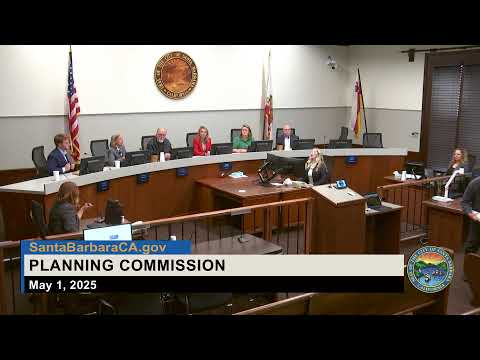
The Santa Barbara Planning Commission on May 1 heard a public environmental review and invited comments on the Draft Environmental Impact Report (EIR) for the Los Patos Underpass removal project, a companion action to the Highway 101 HOV widening and Caltrans ramp work. City engineers and planners described the project's purpose, possible environmental effects and mitigation measures and said the EIR public comment period closes May 27.
City supervising design engineer Eric Goodall told commissioners that Union Pacific Railroad requested removal of the Los Patos underpass after Caltrans closes the adjacent southbound off-ramp, saying the railroad preferred removal “to avoid a public nuisance and continued maintenance once that freeway off ramp is closed.” Senior planner Adriana Cornett, speaking for Public Works, summarized the EIR’s findings and the project schedule and said the document identifies tree loss, potential effects to biological resources, cultural/tribal resources tied to a structure-eligible bridge and hazards as the principal environmental concerns.
The EIR identifies several significant unavoidable impacts, Cornett said, including the loss of trees and the removal of a structure the Historic Landmarks Commission (HLC) considers a structure of merit. Cornett told the commission the document estimates about 100 trees could be removed but that number is “an approximate number, and it’s probably an overestimation.” She said boots-on-the-ground replacement locations have not been finalized and that Union Pacific’s right-of-way rules will limit replanting on railroad property.
Commissioners pressed staff for more specifics. Commissioner Barnwell asked to see parcel lines and how the driveway and access for Streets crews would work; Commissioner Wisscomb pushed for identification of off-site sites for a 1:1 tree replacement where possible and noted the city’s vacant tree-well GIS layer and an older Shade Study as potential places to plant replacements. Cornett and consultant Eric Von Berg of Rincon explained the EIR analyzed a study area larger than the immediate footprint to account for potential temporary features such as a shoe-fly track alignment; staff said the shoe-fly corridor—not the bridge itself—contains most of the potentially affected trees.
Commissioners and staff also discussed: staging areas and construction parking (staff said a staging area was identified and is being negotiated with a property owner), the timing and form of an interpretive display about the historic bridge (HLC recommended documentation, 3-D scanning and onsite interpretation; Cornett said HLC review and HLC approval of display details would take place before construction), hazardous-materials mitigation (Cornett said a soils management plan is planned under HAZ-1 mitigation), and outreach for people living in nearby encampments (Vice Chair Boss asked staff to describe the city’s coordination plans for any occupants who may be displaced during construction; staff said the city has an outreach policy to follow and recommended documenting that in the final EIR).
Commissioners repeatedly asked that staff return with more definitive plans before certification: specifically, identified off-site tree-replacement sites or a binding tree-replacement strategy, a mitigation monitoring and reporting plan (MMRP) that specifies monitoring years and responsibilities, defined construction staging and parking areas that minimize impacts to recreational access at the nearby bird refuge, and documented coordination with Union Pacific Railroad over salvage and reuse of sandstone and steel. Cornett said staff planned to incorporate HLC comments (including salvage and reuse options and a potential high-resolution 3-D scan) into the final EIR and to return to HLC and ABR (Architectural Board of Review) for required design approvals prior to construction.
No final decision or vote was taken at the hearing; the item was a CEQA adequacy hearing. Staff noted next steps: the public comment period for the Draft EIR ends May 27 at 5 p.m.; staff will compile comments, revise the EIR as appropriate, and bring a final EIR and the coastal development permit (for the portion in the coastal zone) back to commissions for certification and permit decisions.
Commissioners closed the hearing after asking for clearer, site‑specific mitigation commitments in the final document.