Get Full Government Meeting Transcripts, Videos, & Alerts Forever!
Get email alerts on the Wildfire Preparedness topic
No spam. Unsubscribe anytime.
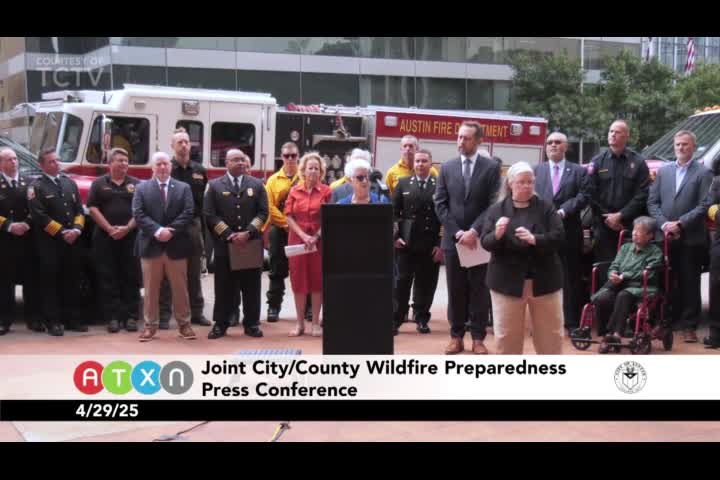
Travis County, Austin officials urge residents to harden homes and sign up for alerts during Wildfire Awareness Month
Summary
Travis County Judge Andy Brown, Austin Mayor Kirk Watson and local fire chiefs urged residents to create defensible space, get ignition-zone evaluations and register for Warren Central Texas alerts as wildfire risk rises across the Austin area.
Travis County Judge Andy Brown and Austin Mayor Kirk Watson urged residents at a joint press event in Austin to prepare now for wildfire season, emphasizing yard hardening, evacuation planning and signing up for emergency alerts.
The warning comes as local officials said the city’s wildland-urban interface (WUI) now covers a larger share of habitable land and recent regional fires have demonstrated how smoke and embers can spread rapidly. "We often see dry grass, low humidity and strong winds, and these are the perfect conditions to start a small fire that gets bigger and gets out of control very quickly," Judge Andy Brown said. "That's why we're asking everybody to take wildfire safety seriously and to take some simple steps to get prepared."
Officials said the updated WUI map approved recently by Austin City Council now classifies about 51% of Austin's habitable land as at-risk, up from about 38% nearly a decade ago. The shift reflects both growth in homes at the wildland edge and revisions to how risk is mapped. "Austin ranks fifth in the nation in the number of homes at risk of wildfire," Mayor Kirk Watson said, and he cited population growth and new homes built in the wildland-urban interface as drivers of heightened exposure.
Local fire officials and elected leaders outlined concrete steps residents can take. Judge Brown described the need to create a defensible space around homes by clearing dry leaves, dead plants, tall grass and woodpiles and by trimming tree branches "so they're at least 10 feet away from your roof." Assistant Chief Jeff Kennedy of the Austin Fire Department encouraged similar home-hardening measures and recommended covering vents with 1/8-inch mesh and keeping trees trimmed at least eight feet from structures. "You can request a free structure ignition zone evaluation from the AFD wildfire division or any of our ESDs," Kennedy said.
Travis County Emergency Services District 9 Fire Chief David Wilson reiterated that more than 90% of wildfires are caused by people or infrastructure and urged residents to sign up for emergency alerts at WarrenCentralTexas.org and to prepare a go-bag, identify multiple evacuation routes and harden homes by cleaning gutters and trimming vegetation. "Hardening your home is one of the best things you can do to reduce your vulnerability for wildfires," Wilson said.
Officials warned about ember-driven ignitions: embers can travel far from a blaze and ignite structures downwind. Kennedy said embers can travel "up to a mile and a half" and that embers, not direct flames, are often responsible for home ignitions. The recent Gillespie County blaze that burned more than 10,000 acres and darkened skies in Austin was cited as a recent reminder of the danger.
On evacuation planning and coordination, Jim Reddick, director of the City of Austin Homeland Security and Emergency Management, said evacuation orders would come from responders who have delegated authority from the mayor or the county judge and that evacuation routes and phases will depend on the incident, wind and conditions. Reddick said officials exercised evacuation plans with partners last week and said the finalized evacuation plan would be published by June 1. "This particular threat, wildfire, we actually exercised last Friday," Reddick said. "The evacuation order would be coming from the responders who have that delegated authority from the mayor or the county judge."
Several officials addressed reliance on state and federal resources. When asked about FEMA restructuring, Judge Brown said he has a strong working relationship with Chief Kidd of the Texas Division of Emergency Management and stressed the county's reliance on federal assistance in major disasters. Mayor Watson and Judge Brown both expressed concern about potential federal changes affecting funding or personnel but said they have confidence in current state partners.
Speakers repeatedly urged residents to register for Warren Central Texas alerts, get free ignition-zone evaluations from local fire departments or emergency services districts (ESDs), and to check and clear their properties. Travis County Fire Marshal Carrie Howell described the seasonal outlook as likely "a hot dry summer" and cautioned that drought conditions were expected to continue.
Officials closed by urging community cooperation: create defensible space, communicate with neighbors about vulnerability and needs, and follow local instructions during high-risk conditions. "We need once again to work together," Judge Brown said, noting that emergency responders are trained and ready but cannot prevent damage alone.
Ending details: officials listed resources and local points of contact for evaluations and community outreach, and encouraged residents to call 911 immediately if they see smoke or flames so small fires can be stopped before becoming large incidents.