Get Full Government Meeting Transcripts, Videos, & Alerts Forever!
Get email alerts on the Higher Education topic
No spam. Unsubscribe anytime.
Assembly Higher Education Committee advances task force for Chula Vista university district, nursing pilot and student medical-amnesty protection; multiple bill
Summary
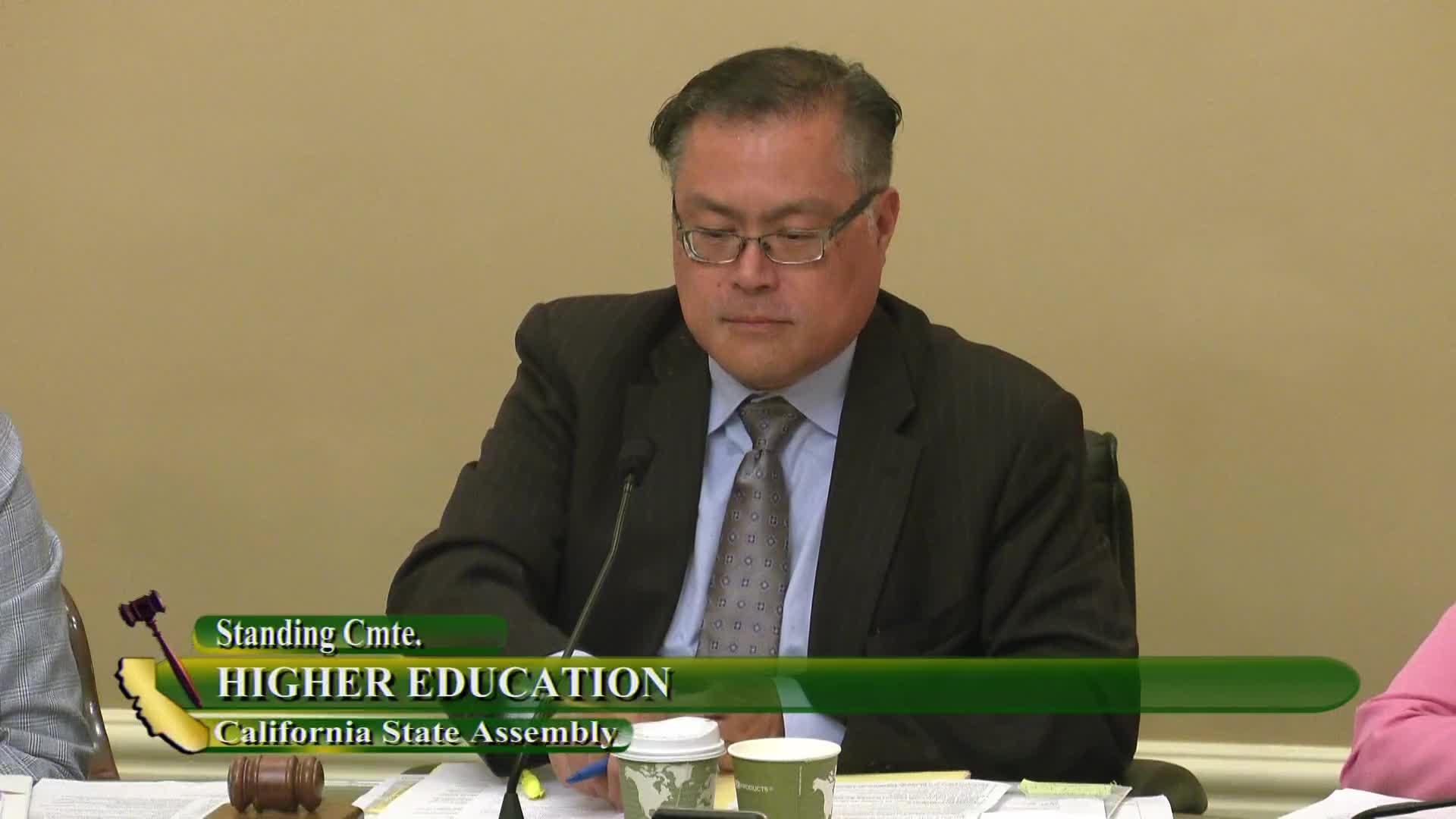
The Assembly Higher Education Committee on May 20 moved a package of bills aimed at expanding local higher-education access, addressing health-care workforce shortages and protecting students who seek emergency medical aid.
The Assembly Higher Education Committee on May 20 moved a slate of bills and resolutions that together aim to expand access to higher education, shore up health-care workforce pipelines, and change how campuses handle certain student emergencies.
Top actions included sending AB 662 — a measure to create a South County Higher Education Task Force to study a mixed-use intersegmental institution anchored in Chula Vista — to the Appropriations Committee; advancing AB 1400, a pilot to allow up to 15 community college districts to offer a Bachelor of Science in Nursing (BSN); and approving AB 602, which shields students from some campus discipline if they call for emergency medical help in an alcohol- or drug-related medical emergency.
Why it matters: the batch of bills touches several recurring problems members said they hear from constituents: limited campus capacity in some fast-growing regions, shortages of nurses and physicians in rural and Central Valley communities, and student safety on campus. Committee members and outside witnesses framed each bill as a piece of a broader effort to keep students and workers connected to local pathways to jobs and to reduce barriers to completion.
AB 662 — South County higher-education task force Assemblymember Alvarez presented AB 662, which would form the South County Higher Education Task Force to examine governance models, funding mechanisms, and statutory barriers for creating a mixed-use, intersegmental higher-education presence in Chula Vista. "For too long, the absence of a nearby 4-year public institution has limited educational and economic opportunities for our residents," Assemblymember Alvarez said in opening remarks. Southwestern College and the city of Chula Vista testified in support, stressing the region has a "college desert" despite UC San Diego and San Diego State being located in the county.
Committee action: the measure passed as amended and was referred to the Appropriations Committee.
AB 1400 — Community college BSN pilot (nursing workforce) Assemblymember Soria presented AB 1400, a pilot that would allow the chancellor's office to select up to 15 community college districts to offer a BSN. Supporters including community college leaders and the California Hospital Association told the committee that the long-term shortage of registered nurses (projected statewide shortfall cited in testimony) is most acute in rural areas and that public institutions currently lack capacity. The California State University (CSU) and some nursing associations opposed or urged changes, saying the bill does not address the primary bottlenecks—clinical placements, qualified faculty and infrastructure—and could draw faculty away from existing programs.
Committee action: the committee passed AB 1400 and sent it to Appropriations; members asked the author and stakeholders to continue negotiations about program safeguards, evaluation and clinical placements.
AB 602 — Student medical-emergency protection A measure presented on behalf of Assemblymember Haney, AB 602 protects students at California public colleges and universities from certain campus disciplinary sanctions when they or someone they witnessed call for emergency medical help for an alcohol- or drug-related medical emergency. Witnesses described instances where fear of disciplinary penalties delayed emergency calls. A student who testified said the bill will remove a "choice between saving a life and risking...housing, academic standing, or future." The measure explicitly does not shield conduct involving sexual assault, hazing, or other violations that fall outside the stated emergency medical context.
Committee action: the committee passed AB 602 as amended to comply with federal reporting requirements and to allow campus escalation for repeat incidents; the bill was referred to Appropriations.
AB 694 — Study on Cal/OSHA (DOSH) staffing and recruitment Assemblymember McKenna presented AB 694, which would require the Department of Industrial Relations to contract with specified university labor/occupational programs to study causes of inspector vacancies at the Division of Occupational Safety and Health and recommend workforce-development solutions. Witnesses from worker and labor coalitions said Cal/OSHA (DOSH) faces vacancy rates that hinder enforcement of heat, smoke and other standards and argued for pathways into civil-service inspector roles that do not require advanced degrees.
Committee action: the committee moved AB 694 to Appropriations.
ACA 3 — UC down-payment loan measure (constitutional amendment) ACA 3 would put before voters an amendment to authorize the University of California to make a limited set of down-payment loans for UC support staff who are first-time homebuyers, prioritized for lower-income staff. Supporters argued the proposal uses internal UC investment pools and would not affect tuition or general fund spending; UC leadership and several campus administrations said the measure is unnecessary because the state already funds similar shared-appreciation loan programs through CalHFA and that UA'C and UC are negotiating a CalHFA agreement.
Committee action: the committee voted to advance ACA 3 for further consideration; members debated whether the program should be state-run or administered via CalHFA and whether the proposal in its current form picks winners among potential homebuyers.
Other measures advanced - AB 95 — California Education Interagency Council (coordination among K'12, higher ed and workforce partners): passed and referred to Appropriations. Supporters said California lacks a coordinating body and that the council would improve strategic use of workforce and education funds. (See bill text in file.) - AB 958 — Adds a second faculty trustee to the CSU Board of Trustees: advanced as amended; supporters (faculty leaders) argued it improves shared governance. - AB 1028 — Minimum communications for community college temporary employee terminations: passed to Appropriations; sponsors said the measure extends local-bargained due-process procedures or, where none exist, guarantees a written explanation on request. - AB 1247 — Limits on contracting out classified school positions; sponsors said the bill raises training and pension parity issues; the committee advanced the measure amid an extended exchange with school-district groups about unfunded mandates and operational flexibility. - AB 893/AB 885/AB 730 and other items on workforce, tuition/affordability, and campus construction standards were also advanced to Appropriations or otherwise acted on; the committee took roll-call votes on all items.
Votes at a glance (select items) - AB 662 (item 5) — South County Higher Education Task Force: passed as amended to Appropriations (committee vote recorded in transcript). - AB 602 (item 4) — Student medical-emergency protection: passed as amended to Appropriations. - AB 694 (item 6) — Cal/OSHA staffing study: passed to Appropriations. - AB 1400 (item 14) — Community college BSN pilot: passed to Appropriations; substantial debate on clinical placements and CSU partnership models. - ACA 3 (item 16) — UC support-staff down-payment loans (constitutional amendment): advanced for further consideration; committee debate noted UC opposition and existing CalHFA programs. - AB 1247 (item 13) — Rules on contracting out classified school positions: advanced to Appropriations amid opposition from county superintendents and school administrators. - AB 958 (item 9) — Add a faculty trustee to CSU Board: passed as amended to Appropriations. - AB 1028 (item 10) — Temporary employee termination communication at community colleges: advanced to Appropriations.
What committee members said Members across the aisle framed many of the proposals as trying to address long-term access or workforce problems, but some asked for stronger cost, operational and legal guardrails. Several members urged continued negotiation between segments, districts, and unions where the bills intersect with collective bargaining or existing federal-state programs.
What happens next Bills referred to the Appropriations Committee may be held for fiscal review and will return to the floor only if the committee votes them out of Appropriations. Several authors and stakeholder groups were asked to continue negotiations with committee staff and affected segments.
Ending note Witnesses and members repeatedly described the hearing as part of a broader push to connect education to local workforce needs, expand access in regions that lack nearby public university options, and reduce barriers (financial and administrative) that keep students from completing degrees or seeking emergency help. The committee advanced a number of measures that reflect those priorities and asked parties to continue work on clarifying language and implementation details.