Get Full Government Meeting Transcripts, Videos, & Alerts Forever!
Get email alerts on the City Budget topic
No spam. Unsubscribe anytime.
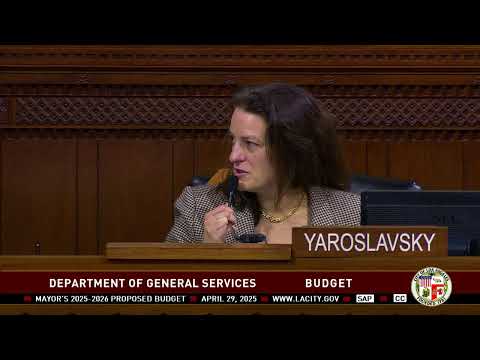
Budget committee hears $900M-plus shortfall, mayoral plan that could eliminate about 1,647 city positions
Summary
Los Angeles mayoral budget proposal for FY 2025–26 projects a structural deficit of more than $900 million and relies on staff reductions, program cuts and department consolidations; committee members pressed for details, protections and options to avoid layoffs.
The Los Angeles Mayor’s Budget Precommittee on April 29 reviewed a mayoral budget proposal that officials said leaves the city facing a structural shortfall of roughly $900 million to $1 billion for fiscal year 2025–26 and a four‑year outlook that depends on deep cuts and program consolidations.
Committee members and city budget staff described a multistep plan that relies on $282 million from eliminating filled and vacant positions, draws on one‑time revenues and reserves, and proposes structural changes including consolidating several departments and commissions. The mayor’s team is proposing the elimination of about 1,647 positions across the city as part of those reductions.
Why it matters: The committee’s deliberations set the stage for which services will be trimmed or restored, how many city employees may be separated or transferred, and how the city prepares for near‑term risks such as a possible national recession, reduced tourism revenue and growing legal liabilities. The measures under discussion would affect public safety services, street repairs, animal services, homelessness programs and the city’s capacity to stage large events including the 2028 Olympics.
Budget picture and approach Budget office presenters told the committee the proposed FY 2025–26 budget assumes weak revenue growth (roughly 0.36 percent in some measures) while cost pressures — higher personnel costs, increased legal claim liabilities and fallout from wildfire impacts and federal trade policy — are expected to widen the gap. “The result of all this is a deficit of more than $900 million,” said Math Health, identified in committee remarks as a budget office presenter. He told members the administration had reduced operating expenditures and deferred capital projects before proposing position eliminations and other structural steps.
City staff described multiple strands of the proposal: spending cuts (including trimming or eliminating some commissions and combining services such as aging, workforce and youth development), planned reductions in recruitment classes for police and fire, and the transfer or consolidation of administrative boards. The mayor’s office proposed preserving sworn public‑safety positions while reducing many nonsworn roles, and keeping core homelessness interventions in the proposed plan but trimming some discretionary supports.
Layoffs, transfers and mitigation options The budget proposes the elimination of roughly 1,647 positions; staff told the committee those eliminations would yield about $282 million in gross savings and additional pension‑related savings when vacancies are considered. The administration said roughly 1,100 current vacancies would produce an estimated $131 million in near‑term savings; fully implementing the full eliminations for a full year would cost far more in labor‑market impacts.
City staff emphasized alternatives they hope the committee will consider, such as (1) negotiating temporary deferment of wage increases for some employees to reduce the need for layoffs, (2) shifting filled positions to special or enterprise funds where operations generate revenue, and (3) pursuing other structural reforms including examining pension contribution policies. “The best direct way to reduce payroll is to avoid adding to the base,” staff said when outlining options.
Officials and council members repeatedly stressed uncertainty in the outlook: revenue from tourism, hotel occupancy and international travel has weakened, and several analysts have placed the city on negative watch for bond ratings. In a downside recession scenario modeled by staff, even if all proposed cuts were adopted the city could still face persistent multi‑hundred‑million dollar deficits in later years.
Questions from committee members and follow‑up work Committee members asked detailed operational questions about how the administration reached headcount and savings targets and requested follow‑up memoranda. Members sought lists showing which positions proposed for removal are funded by fees or federal/state grants (and thus cannot straightforwardly be cut without losing revenue) and asked for analysis of how proposed transfers of positions between funds would affect departmental operations and revenue generation.
The committee chair (referred to in the meeting as the Committee President) and multiple council members pressed the administration for clear, department‑by‑department documents and for calculations that are easy for the public to understand. The chair asked the chief administrative and budget offices for an initial memo (Memo 1) identifying potential savings opportunities and options for restoring services if additional revenue becomes available.
Context and risks Budget staff warned that the outlook depends heavily on a set of assumptions: (a) that the city’s revenue will return gradually to historical trends, (b) that the proposed cuts remain in place for multiple years and (c) that there are no new major labor‑cost increases after current agreements expire. Staff also highlighted three significant risks: an economic downturn; weaker tourism and hotel receipts tied to international travel patterns; and a rise in legal claim payments. Bond rating agencies’ recent actions, staff said, could raise future borrowing costs for major capital projects.
Committee next steps No formal votes were taken at the session. Members requested multiple follow‑up memoranda on projected tourism receipts, department‑by‑department lists of vacancies and the proposed eliminations, and alternative options for reducing layoffs (including internal borrowing and other revenue measures). The committee continued its hearings, with additional departmental presentations and follow‑up questions scheduled for future meetings.
Ending Committee members emphasized the gravity of the choices and asked the administration to provide clearer, more granular materials before any final budget adoption so council members can evaluate trade‑offs between services, staffing and fiscal sustainability.