Get Full Government Meeting Transcripts, Videos, & Alerts Forever!
Get email alerts on the Homelessness topic
No spam. Unsubscribe anytime.
Sacramento council workshop advances ‘micro‑community’ interim housing, seeks funding and public‑private partners
Summary
City staff outlined a multi‑pronged plan to reduce unsheltered homelessness that would slowly shift congregate shelters to smaller interim "micro‑communities," expand prevention, pursue safe‑parking sites and seek contract savings and new revenue offsets. Council directed staff to return with an implementation plan; no ordinance vote was taken.
Sacramento city staff on Tuesday presented the City Council with a data‑driven workshop recommending a set of interim strategies to reduce the number of people living on the city’s streets, including building small “micro‑communities” for seniors and other cohorts, expanding prevention and diversion funding, and pursuing safe‑parking sites for people living in vehicles.
The proposal — delivered by Brian Pedro, director of the Department of Community Response — asked the council to direct staff to develop a plan to stand up three pilot micro‑communities using city property and public‑private partnerships, renegotiate contracts to capture savings, apply for encampment grants and return with an implementation plan that includes fee policy and good‑neighbor protections.
Pedro told the council the city has spent about $115,000,000 on homeless response over the last five years, of which roughly $81,000,000 was one‑time funding such as HAP, ARPA and FEMA grants. He said the city’s system currently has about 1,375 beds and last year spent roughly $34,500,000 serving 4,240 people. "We spent over the last 5 years a hundred and 15,000,000," Pedro said. "81,000,000 of that was 1 time funding so that was either HAP, ARPA, FEMA grants and that was directly towards homeless projects or programs."
Why it matters
Pedro argued that a long runway for permanent supportive housing (PSH) — both because of funding cycles and complex funding paperwork — means PSH alone will not return people to stable housing fast enough to address the city’s unsheltered population. He recommended interim housing options that the city can build faster and operate more cheaply than large congregate shelters while still offering on‑site management and voluntary services.
Key elements and costs
- Micro‑communities: Pedro proposed small, fenced clusters of tiny units with individual doors, plumbing and on‑site management, sized ‘‘40 or less’’ depending on lot size, intended as interim supportive housing. He said setup costs for a 40‑person micro‑community were estimated at about $2,000,000 with annual operations around $200,000 and potential revenue offsets (CalAIM reimbursement, program fees) of about $1,500,000, producing a net cost near $1,500,000 a year. Pedro summarized: "That gives us a subtotal of $3,000,000 with program fees put back into the system…and...bringing that number down to 1,500,000.0 total per year for a micro community to be stood up."
- Congregate shelters: Staff recommended a slow ramp‑down of some congregate shelters into interim options so shelters can be reconfigured without abrupt closures.
- Prevention and diversion: Pedro said the city already redirected $2,000,000 into prevention programs and urged an expansion of those efforts, noting it is generally cheaper to prevent homelessness than to respond to it.
- Contract renegotiation and efficiency: Staff reported nearly $6,000,000 in contract savings from recent negotiations, money Pedro said could be reinvested into micro‑communities and services.
- Safe parking and site mix: The city will pursue a middle ground approach to safe parking (neither bare parking lots nor extremely costly, full‑service programs). Staff said multiple small city parcels could be used for dispersed micro‑communities so projects do not concentrate in one neighborhood.
What the city presented about scale and limits
Pedro walked the council through the city’s point‑in‑time and shelter history, including the expansion of shelters since 2017 and the Project Room Key motel program. He said the state determines Regional Housing Needs Allocation (RHNA) targets and the city needs more than $2.3 billion to fully close the gap on extremely low‑income and PSH units — a multi‑year funding shortfall that, he said, makes rapid interim solutions necessary.
Public comment and council reaction
About 17 speakers addressed the council during public comment on the workshop. Angela Hassell, executive director of Sacramento Loaves & Fishes, urged the council to stop encampment sweeps while alternatives are being created: "Anything that you discuss here or considered today will be ineffective while the encampment sweeps continue," she said. Other speakers described the daily damage caused by sweeps and urged more stable, humane options rather than repeated clearances.
Business and neighborhood leaders — including River District representatives — asked the city to reduce concentrations of encampments near commercial districts and to make 311 and business reporting more effective. State representatives and homelessness partners including the California Interagency Council on Homelessness urged the city not to create barriers that could discourage people from using services.
Council members broadly praised staff for the analysis and asked a series of follow‑up items — including clearer data on incomes of motel program residents, more engagement with neighborhood and community‑based organizations on site selection and services, and a closer look at regional cooperation with the county and adjacent cities. Councilmember Mai Vang explicitly asked for clarity about next steps; staff and the mayor said the council was not taking an ordinance vote this meeting but wanted staff to move forward and return with implementation detail and proposed site lists.
Next steps and council direction
The council did not adopt a new law or make a binding financial appropriation in the workshop. Instead, council members gave staff direction to: - proceed with planning and piloting three micro‑community sites using available city properties and public‑private partnerships; - return with a detailed implementation plan that includes proposed sites, cost breakdowns, a proposed fee policy (if any), good‑neighbor protections, and metrics for outcomes; - pursue additional state and grant funding (including encampment resolution grants) and seek outside partners (health systems, faith organizations, nonprofits) for funding and operations; - expand prevention and diversion funding where effective; and - identify safe parking pilot locations and the legal/operational requirements to run them.
Brian Pedro said the city will not shut shelters immediately and characterized the plan as a way to ‘‘thread the needle’’ between cost, speed and dignity. "We're not gonna grab somebody off the street and say now you have to pay $300 or you can't be in here. That is not it," he said, describing fees as a potential voluntary contribution for some interim beds that would be reinvested in operations.
What the council did formally
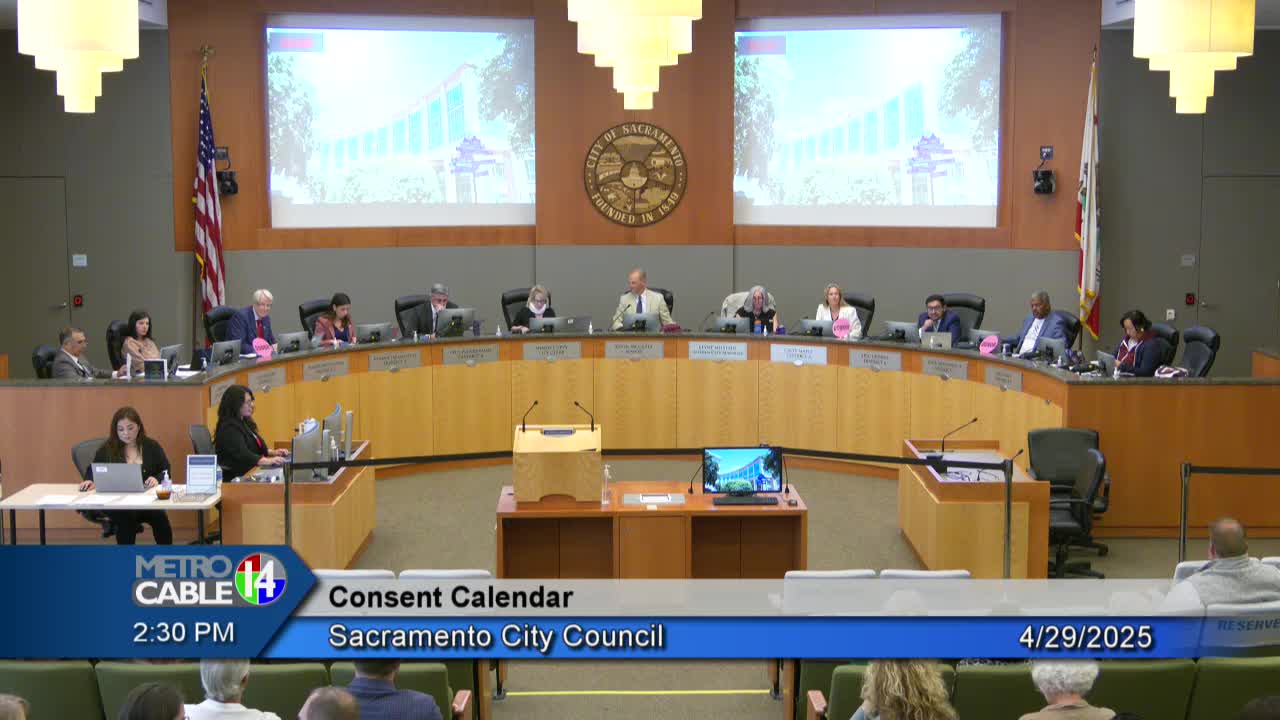
No vote was taken on the homelessness strategies; the item was presented for review, comment and direction. Separately, the council approved the consent calendar earlier in the meeting (motion by Councilmember Guerra, second by Councilmember Maple); the clerk recorded a no on item 2 by Vice Mayor Talamantes, a no on item 23 by Councilmember Dickinson, an abstention on item 14 by Mayor McCarty and a recusal on item 14 by Councilmember Pluckebaum.
Why reporters will watch this
Staff framed the proposal as an attempt to provide faster, lower‑cost, but still supervised and service‑connected alternatives to both tents and slow‑building permanent supportive housing. Because the approach relies on city‑owned parcels, contract savings and grant applications — and because neighborhood distribution, fee policy, and good‑neighbor protections remain open — the council asked staff to return with a concrete, vote‑ready implementation package that will determine how rapidly the pilot can be built and scaled.