Get Full Government Meeting Transcripts, Videos, & Alerts Forever!
Get email alerts on the Water Reclamation Facility topic
No spam. Unsubscribe anytime.
Rapid City receives update on $207.3 million Water Reclamation Facility; commissioning to begin 2027
Summary
Operations engineering manager Eduardo Lopez told the council the Water Reclamation Facility (WRF) is in phase 2, with $207.3 million secured (including $136.5 million SRF loans and $52.8 million in grants) and major construction milestones underway; staff plans public outreach and site tours.
Operations engineering manager Eduardo Lopez updated the Rapid City Council on the Water Reclamation Facility (WRF) project, saying the city has secured $207.3 million for the project and is in phase 2 of construction.
“The plant has been under constant construction since its inception,” Eduardo Lopez said, outlining a timeline that places the project’s expected completion in winter 2028 and the start of system commissioning in 2027. Lopez said the project is the city’s largest infrastructure undertaking to date and aims to meet anticipated future regulatory needs while improving reliability and efficiency.
Lopez gave a funding breakdown: $136.5 million in State Revolving Fund (SRF) loans, $52.8 million in grant funding (described in the discussion as ARPA funds allocated by the state and some city ARPA funds) and $18 million from the city’s enterprise sewer funds, totaling $207.3 million. He said the project has encumbered $204 million in contracts and recorded $40.8 million in completed construction costs; staff has reserved $3 million for contingencies.
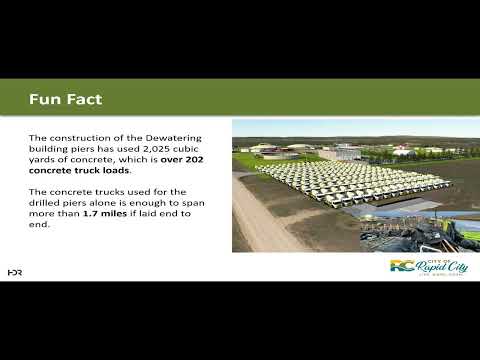
Construction milestones described included placement of concrete for Aeration Basin No. 3, excavation for Secondary Clarifier No. 3 and the RAS/WAS (return activated sludge / waste activated sludge) building, and installation of deep concrete piers for the dewatering building and solids holding tank. Lopez noted the large scale of underground work and the need to reach bedrock in places, and he quantified recent concrete use: about 2,000 cubic yards of concrete for dewatering building piers and another 800 cubic yards for a clarifier pour.
Council members thanked Lopez for a short project video and asked follow‑up questions about funding and rate calculations. Daniel, the finance director, confirmed that the ARPA grant amount was included in calculations for new sewer rates. Several council members said they would be interested in construction tours; Lopez and Water Reclamation Superintendent Dave Van Cleave were listed as contacts for scheduling tours.
Lopez said staff will continue outreach with newsletters (planned for April, August and December), a project website, digital displays in public spaces, and periodic presentations to the public works, legal and finance committee.
No action items were associated with this presentation; the council moved to acknowledge the presentation and then adjourned the meeting.