Get Full Government Meeting Transcripts, Videos, & Alerts Forever!
Get email alerts on the Family Homelessness Prevention And Assistance Program topic
No spam. Unsubscribe anytime.
Minnesota lawmakers and advocates press for funding to keep families from falling into homelessness
Summary
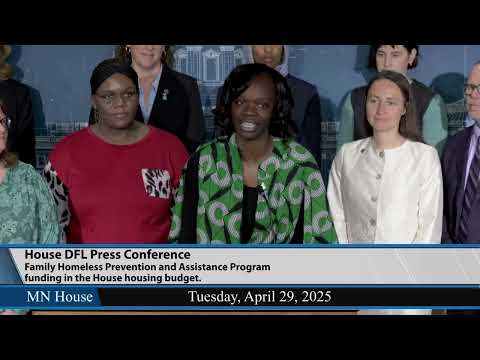
Advocates and Representative Hulda Mamani Hiltzley urged support for House File 2298 and for increased funding to the Family Homelessness Prevention and Assistance Program (FHPAP), citing program effectiveness, current funding shortfalls and a House proposal of $30 million.
St. Paul — Representative Hulda Mamani Hiltzley urged lawmakers to support the housing omnibus bill, House File 2298, and emphasized the importance of funding the Family Homelessness Prevention and Assistance Program (FHPAP) to prevent families from becoming homeless.
"I am urging my colleagues out there as we debate this bill on the floor. Join me in supporting House file 2,298," Representative Hulda Mamani Hiltzley said, framing the proposal as a measure to keep families housed across Minnesota.
Advocates and people with lived experience told lawmakers at the event that FHPAP helps families remain stably housed through emergency rental assistance, mortgage support and utility help. Jenny Larson, executive director of 3 Rivers Community Action, said the program operates across a 20-county region in southeast Minnesota and that the state investment is cost-effective for preventing homelessness. "We calculate that on average, it costs us about $3,500 to help resolve a crisis in a household," Larson said, and she contrasted that with an estimate that it could cost "as much as $45,000 to bring that same family out of homelessness."
Miara Allen, who identified herself as a single mother of six, described how assistance preserved housing stability for her family: "These services are not just about housing. They are about keeping families together, giving children a safe place to grow, and giving parents like me a chance to breathe," Allen said. Nalima Sitati Munene, executive director of ACER (African Career Education and Resources Inc.), read a prepared statement from Tamida Gaines, a tenant leader who said FHPAP rental assistance allowed her to remain employed and housed after a pay cut and short-term disability that covered only part of her income.
Advocates noted that demand exceeds available funding. Larson and other speakers said providers typically open FHPAP applications on a quarterly schedule to avoid exhausting funds early in a biennium and that some service areas run out of money before the quarter ends. Representative Hiltzley and other speakers described the program as a priority in the House bill; Hiltzley said the House settled on $30,000,000 for relevant housing investments, while a questioner noted a $20,000,000 difference between House and Senate versions of the bill.
Panelists also described the bill’s blend of short-term assistance and housing production measures. Larson noted provisions the group identified in the bill: a $100,000,000 housing infrastructure bond program for production, $10,000,000 for a challenge fund intended to leverage local investment, and roughly $3,000,000 for an affordable homeownership initiative. She said provisions aimed at Greater Minnesota were intended to direct resources to places where housing development and service distances are larger.
Speakers urged conference committee negotiations and additional appropriations to reduce unmet need. Representative Hiltzley referenced a prior FHPAP task force and said work remains to speed distribution and simplify access. No formal legislative action or vote occurred at the event; speakers asked colleagues on the floor to adopt the House provisions as the bill moves forward.
At the close of the event, Hiltzley reiterated the program’s aims and fiscal case: "When we talk about housing, we're not just talking about structure. We are talking about stability. We are talking about dignity," she said, urging lawmakers to consider both the human and financial stakes as negotiations continue.