Get Full Government Meeting Transcripts, Videos, & Alerts Forever!
Get email alerts on the Contracts Mtsu Hustle topic
No spam. Unsubscribe anytime.
Opioid Abatement Council approves revised MTSU contracts after $400,000 reallocation to mileage
Summary
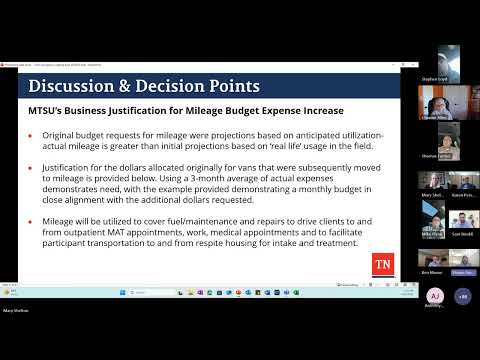
The Tennessee Opioid Abatement Council voted to approve revised three‑year contracts with Middle Tennessee State University and Hustle Recovery that remove 10 vans and reallocate the $400,000 originally budgeted for vehicles to mileage reimbursements, with new oversight measures for mileage reporting.
The Tennessee Opioid Abatement Council on April 28 approved revised three‑year contracts with Middle Tennessee State University (MTSU) and Hustle Recovery that remove provision for 10 vans and reallocate the $400,000 originally budgeted for those vehicles to mileage reimbursements.
Council Chair Dr. Steven Lloyd announced the vote after staff presented the revised budgets and a comptroller recommendation to subcontract services provided by Hustle Recovery if MTSU is the direct contractor. Executive Director Mary Shelton said the council has negotiated two separate contracts: one for expansion of respite housing (about $5,300,000 over three years) and one for a residential aftercare program (about $3,300,000 over three years). She told the council the ten vans previously in the two contracts accounted for approximately $400,000 and that MTSU proposed reallocating that amount to mileage costs.
The office described the mileage reimbursement at 70 cents per mile and said MTSU justified the increase on the basis of actual use being higher than the original estimates. MTSU and Hustle Recovery proposed oversight measures: monthly mileage logs Hustle Recovery must submit, a program coordinator at MTSU to review those logs and reports based on a Life360 application Hustle Recovery uses, and additional internal review. MTSU representatives also said they had revised the budget to preserve the original total contract amounts rather than increasing the contract totals.
Hustle Recovery staff explained that some services will continue to use owned, grant‑purchased vehicles and that staff personal vehicles will be used only to supplement transportation when needed. Troy Sander of Hustle Recovery said staff drivers have required endorsements and personal liability insurance; the non‑owned/hired vehicles will be covered by a $1,000,000 auto liability policy with a $2,000,000 umbrella.
Council discussion focused on the oddity of replacing a fixed‑asset line item (vans) with an identical dollar amount for mileage and on how the program will verify and oversee mileage reporting. Dr. Ken Moore, who moved approval, said the contracts represent a small portion of the total grant funding to MTSU and that the tracking procedures proposed were sufficient for him to support moving forward. Dr. Moore moved approval; Brian Buck seconded. In the roll call that followed, all present members voted yes except Chair Steven Lloyd, who recorded an abstention. The motion carried.
What the council approved was the office recommendation to proceed with contracting based on the revised budgets and the additional oversight steps described. Staff said the reallocation does not increase the total amount of either contract and that any overage would be absorbed by the service provider while unspent funds would remain as unspent allocations.
The council asked staff to continue monitoring actual mileage against the projected reimbursements and to report back if the variance grows beyond the small quarter‑to‑quarter differences staff observed in a three‑month sample.