Get Full Government Meeting Transcripts, Videos, & Alerts Forever!
Get email alerts on the Spatial Vr Education topic
No spam. Unsubscribe anytime.
Prisms VR founder urges state appropriation to scale spatial VR math and science program in Michigan
Summary
Anarupa Ganguly, CEO of Prisms VR, told the House appropriations subcommittee that her company’s spatial VR curriculum embeds algebra and science concepts in career‑connected simulations and that early results and a WestEd randomized trial showed measurable gains; she asked for appropriation to expand to more high‑need Michigan students.
Anarupa Ganguly, founder and chief executive officer of Prisms VR, told the House Appropriations Subcommittee on School Aid and the Department of Education that spatial virtual reality lessons that embed core math and science concepts in career‑connected, first‑person problems have improved algebra proficiency in early deployments and should be scaled to additional high‑need Michigan students.
Ganguly described Prisms as a spatial learning platform that uses virtual reality to immerse students in real‑world jobs — for example, having students act as epidemiologists observing infection spread, air traffic controllers, or building engineers — and then guiding learners from embodied experience to two‑dimensional tables and algebraic notation. "We build from virtual reality because what virtual allows you to do, it allows you to suspend disbelief and go to the seat of a problem," Ganguly said.
Evidence and teacher supports
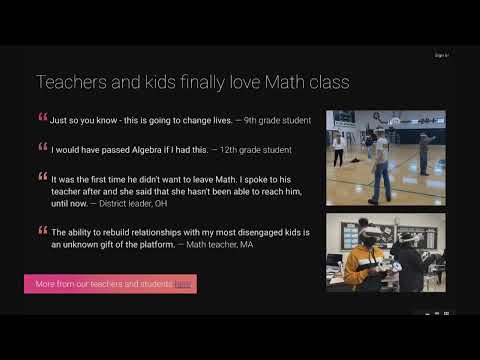
Ganguly said Prisms has been used with roughly 15,000 Michigan students as part of broader deployments in 37 states and that WestEd — a third‑party research partner — ran a randomized control trial in Ohio showing an 11% increase on benchmark Algebra 1 assessments in year one among students who used the platform. She emphasized extensive teacher professional development, job‑embedded coaching rounds and a teacher dashboard that lets instructors monitor and intervene in real time.
Deployment, target students and request
Prisms targets middle and high school students (grades 6–12), with a focus on rural and Title I schools and students who have struggled in traditional interventions. Ganguly said the company requests a state appropriation to expand from current Michigan footprints to reach an additional 50,000 high‑need students within 18 months, citing hardware and teacher up‑skilling as the primary cost drivers.
Committee reaction
Representative Glanville praised the brain‑science grounding of the approach, noting that curiosity and embodied learning improve retention. Committee members asked scheduling and implementation questions; Ganguly highlighted that teachers remain central to delivery and that Prisms pairs VR modules with paper‑and‑pencil reflection and teacher debriefs to align with assessments.
Provenance
topicintro: Prisms VR presentation introduction (block_id:3671.125). topicfinish: close of Prisms VR presentation and handoff (block_id:4864.895).