Get Full Government Meeting Transcripts, Videos, & Alerts Forever!
Get email alerts on the Transit Finance topic
No spam. Unsubscribe anytime.
Richardson officials briefed on DART plan to share sales-tax growth with cities through interlocal TIF-like agreements
Summary
City of Richardson staff and DART representatives described a draft master interlocal agreement that would let the transit agency share municipal sales-tax growth with member cities to finance transit-oriented projects for up to 10 years after activation.
City of Richardson staff and Dallas Area Rapid Transit officials on Thursday briefed the Richardson City Council on a proposed regional approach to allow DART to participate in tax-increment finance-style projects using municipal sales tax.
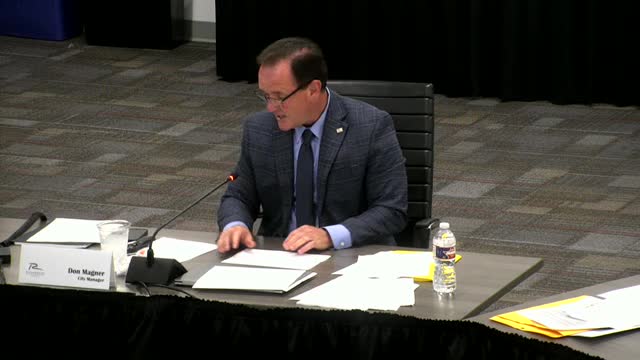
City Manager Don (last name not specified) and DART board chair Gary Slagle described a draft master interlocal agreement, developed by DART staff and a working group of city managers, that would allow DART to commit a share of municipal sales-tax growth inside defined zones to support transit-oriented development (TOD) near transit anchors such as stations, park-and-rides and transit centers.
The proposal responds to limits in existing Texas law for a transit agency’s direct participation in tax increment reinvestment zones (TIRZ/TIF). Council staff said the draft uses a master ILA and subsequent city-level letters of concurrence to create a “quasi-TIF” that shares incremental sales-tax receipts with DART for a 10-year term from the activation date. DART staff described safeguards intended to keep the agency “whole” for baseline sales tax—DART would use the higher of a one- or two-year look-back to set a base remittance and would share only the incremental growth thereafter.
Under the draft approach, DART’s participation in any project would generally be capped at 50% of the sales-tax increment, with some exceptions (for example, federally funded stations) where DART might participate at a higher share. Cities would be required to match DART dollars with city funds for every DART dollar spent. The ILA template under discussion would last five years; cities would opt into the master ILA and then activate specific zones or projects that would trigger up to 10 years of DART payments.
Richardson staff highlighted eligible uses that are more transit- and mobility-focused than typical TIF uses: streets, sidewalks, parking structures at TOD sites, mobility improvements, TOD project costs and other items allowed under Chapter 452 (as referenced in the briefing). Council members asked about administration, distance to anchors, how base years are set and safeguards if DART service at an anchor changes. DART and city managers said the proposal allows substitution of a transit anchor within a zone (for instance, replacing one station with another within the same zone) and permits the DART board to review one-off requests outside the template.
Council members broadly praised the collaborative effort. Gary Slagle said the approach could help cities compete regionally and boost both ridership and sales-tax growth. Council members urged prompt action at the state level to avoid legislation that would limit DART’s ability to participate; several council members suggested sending a letter to state legislators explaining the regional agreement. Staff said the DART board would review the master ILA at its upcoming meetings and that cities would have time to opt in before a December deadline specified in the template.
Why it matters: The proposal would provide a new funding tool to align development around transit stations across the DART service area, using shared sales-tax growth to finance public infrastructure that supports transit-oriented development. Supporters said it could speed projects and increase regional coordination; critics and some council members urged careful local oversight and clear public engagement about where funds would be invested.
What happens next: DART staff planned to brief their board and the committee of the whole in May; Richardson staff said they would return to council with additional materials and recommended language after the DART board’s action. Council members also discussed sending an informational letter to the state legislature about preserving local and regional flexibility.