Get Full Government Meeting Transcripts, Videos, & Alerts Forever!
Get email alerts on the Emergency Services District topic
No spam. Unsubscribe anytime.
Collin County discusses emergency services district; cities split on including extraterritorial areas
Summary
County staff reported which cities consented to include their extraterritorial jurisdictions in a proposed Emergency Services District (ESD); officials warned residents in excluded ETJs may lack county or ESD fire and EMS service unless their city provides it or they opt out of the ETJ before statutory deadlines.
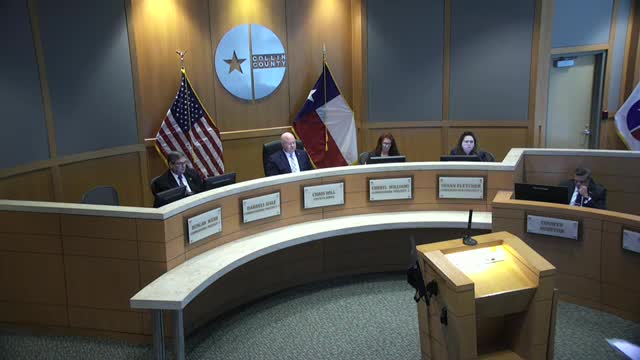
Collin County officials updated Commissioners Court on April 28 about a petition to create an Emergency Services District covering unincorporated areas and city extraterritorial jurisdictions (ETJs), and outlined options for residents in ETJs that cities choose to exclude.
The county’s presentation listed cities that have given consent to include their ETJs in the proposed ESD — Blue Ridge, Celina, Farmersville, Fate, Josephine, Lebonne, Lowry Crossing, McKinney, Melissa, Murphy, Nevada, Princeton, Weston, Wylie and Royce City — and named cities that have definitively declined: Frisco, Lucas, St. Paul and Van Alstyne. Several cities remain undecided (Anna, New Hope, Parker and Prosper) and others had not responded (Allen, Garland, Hebron and Trenton), county staff said.
The update matters because county staff told the court that if a city does not consent to include its ETJ, residents in that ETJ would not be eligible to vote in the ESD election and, should the ESD be approved, would not receive fire or ambulance services from the county or the ESD. “They’re essentially going to not have fire protection from either the county or the ESD, and so they’ll have to look to their city for fire protection,” a county staff presenter said.
Why this matters: the county is shifting responsibility for fire and emergency medical services to the ESD if voters approve. That shift could leave some residents without a local provider unless their city agrees to provide service, the court said.
Court members discussed how to notify affected residents and what options residents have if their city excludes the ETJ. County staff said the statutory opt-out process created by recent state law requires a property-owner petition to the city and that, if a city does not respond within 45 days, the petitioner is deemed to have opted out by operation of law. County staff advised residents who want to be included in the ESD vote to begin the opt-out process in May and said June 9 would be a practical cut-off to ensure the 45-day window runs before the county finalizes ESD boundaries in a public hearing scheduled for July.
Commissioners asked county staff to provide plain-language materials and outreach. The court directed staff to update the county website with a list of which cities have consented, to draft a short guide and sample petition forms consistent with the statute, and to consider using county emergency notification tools such as Everbridge to reach affected addresses. Staff also said they would coordinate with GIS, the elections department and the appraisal district so that property records and ballots reflect timely opt-outs.
Court members and staff repeatedly emphasized that residents in ETJs should contact their city councils to learn whether the city will provide fire and EMS service for the ETJ. County staff noted that a city that opts not to include its ETJ in the ESD could still choose to provide service at the city’s expense; conversely, a city could decline to provide service.
Courtmembers acknowledged the outreach presents a communication challenge because many residents do not vote in city elections for the council that governs their ETJ. Commissioners asked staff for a one-page explanation of options — including opting out of the ETJ, remaining in the ETJ and asking the city for service, or annexation into the city where possible — and for an outreach plan to reduce confusion before the July boundary hearing.
The court did not take a final vote on forming the ESD at the meeting; staff said the court had previously set a public hearing in July to consider and set ESD boundaries and the county will continue to collect city consents and public input before any election is called.
Ending: County staff said they will publish updated consent status on the Collin County website, assemble sample opt-out forms, and ramp up targeted outreach in May and June so residents have time to act before boundary-setting and any subsequent election.