Get Full Government Meeting Transcripts, Videos, & Alerts Forever!
Get email alerts on the Tda Reform topic
No spam. Unsubscribe anytime.
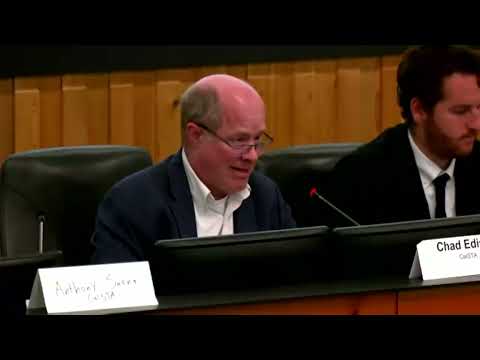
Task force debates TDA reform and revenue options; members approve directing funds to transit in most cases
Summary
Staff presented scenarios for operating and capital needs and a menu of revenue options. After debate the task force approved several process changes for TDA reform and voted to require that Local Transportation Funds be spent on transit except where no transit exists.
Staff presented updated analysis of likely operating and capital costs for transit over the next decade, and a menu of potential revenue sources. The operating scenarios showed wide variance depending on assumptions about service levels and unit costs; staff presented illustrative capital scenarios that ranged from roughly $3.6 billion to more than $11 billion per year in 2035 depending on assumptions about fleet electrification and program scale.
The staff memo set out near‑, mid‑ and long‑term frames for action: near‑term stabilization to avoid immediate service cuts; mid‑term revenue and program changes to support a ‘‘transit transformation’’ of more service and higher reliability; and long‑term structural change to produce sustainable operating support.
Possible new revenue sources included reauthorization of cap‑and‑trade (GGRF), a future road user charge to replace declining gas tax revenues, expanded use of value capture and property‑linked financing, corporate and high‑income taxes, payroll levies, and expanded federal and state grants. Staff presented a simple illustration: adding roughly $1.25 billion a year to the statewide transit budget could be achieved by incrementally allocating portions of personal income, corporate, payroll or other tax bases; staff used the figure as an illustrative target to compare options, not as a recommended tax design.
Task force members debated the scope and urgency of TDA reform. Several members asked that the body go beyond a stakeholder working group and instead propose specific replacement metrics for the TDA’s farebox recovery and efficiency criteria; others said the task force should create a statutory process that produces final metrics on a defined schedule. The group also discussed the TDA ‘‘unmet needs’’ process; several members and advocacy commenters said the process is not delivering transit improvements, while representatives of rural areas asked for protections for regions that rely on LTF for non‑transit local services.
A motion to eliminate the unmet‑needs hearing process and require that Local Transportation Funds (LTF) be spent on transit unless no transit service exists passed after amendment. The approved language requires that LTF be spent on transit where a transit system is present; if an area has no transit, funds may be redirected. The task force also adopted a motion to approve a set of staff TDA reform recommendations (UU and WW items), while deferring UU‑2 (a working group on metrics) for further detail and adding direction that staff return with a tighter proposal on metrics.
Ending: Staff will return with additional detail on TDA metric options, implementation pathways and a clearer financial baseline for the next meeting. Members urged parallel work to define service outcomes so revenue needs can be tied to measurable access goals.