Get Full Government Meeting Transcripts, Videos, & Alerts Forever!
Get email alerts on the Syria Political Transition topic
No spam. Unsubscribe anytime.
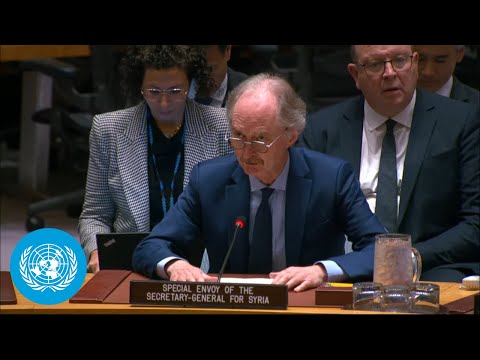
UN official urges inclusive political transition, sanctions relief and accountability in Syria
Summary
A senior United Nations official told the Security Council that Syria’s political transition remains fragile and urged inclusive governance, support for disarmament and reintegration, easing of sanctions to revive the economy, and transparent investigations into recent violence.
A senior United Nations official, briefing the Security Council in New York, said Syria’s political transition is “at a critical juncture” and urged international support for an inclusive process, economic measures to ease civilian suffering, and accountability for acts of violence.
The official said it has been “only 4 and a half months since the fall of the former regime and the opening of a new chapter in Syria’s history” and that the country remains “inherently still extremely fragile.” The official called for “genuine political inclusion so that all Syrians can participate meaningfully in shaping their country's political future,” and said the legal vacuum preceding a recent constitution declaration had been “partly filled” but that much work remains.
The briefing listed specific concerns: a new cabinet that includes one woman among 22 members; lingering armed groups and a continued risk of revenge-driven attacks; reports of recent violence on the coast that have damaged confidence; and a need for transitional justice and rule-of-law measures. “Many women are telling us that they are worried about societal and political trends,” the official said.
The speaker discussed engagements in Damascus with interim authorities, including interim president Al Shara and minister Shevani, and said the United Nations and interim authorities had discussed options for forming an interim people’s assembly charged with urgent legislative reforms. The official described discussions about a future constitutional process as needing to “involve all of Syria's societal and political components” rather than being only a technical exercise.
On accountability, the official said the National Investigative and Fact-Finding Committee’s mandate has been extended for three months and appealed to Syrians with allegations of violence to engage with the committee. The official urged the interim authorities to make the committee’s findings public “in line with international standards” and to take steps “to bring perpetrators of violence against civilians to justice.”
The briefing flagged security challenges in Northeast Syria, where the official welcomed recent committee formations, reciprocal visits, a negotiating approach among Kurdish parties, and an agreement of mutual security arrangements in parts of Aleppo City. The official cautioned, however, that ISIL presence inside and outside camps, diminishing international funding, armed forces operating outside Damascus’s command, and complex demographic and political issues present “major challenges and risks.” The official said de-escalation steps should feed into the broader political process "in line with the key principles of Security Council Resolution 2254."
The official also raised cross-border and regional security issues, saying an early-April confrontation beyond the 1974 lines resulted in “nine civilian casualties on the Syrian side according to the Syrian Arab Republic,” and that a wave of Israeli air strikes on Damascus, Hama, and Homs reportedly caused casualties, including civilians. “These attacks must cease,” the official said, and reiterated an appeal for respect for the 1974 disengagement-of-forces agreement.
On the humanitarian and economic front, the speaker told the council that humanitarian assistance is shrinking and that Syria’s economy is “truly disastrous.” The official welcomed recent meetings between Syrian financial officials and the World Bank and the International Monetary Fund and endorsed measures to ease sanctions that currently hamper economic recovery and delivery of essential services. The briefing noted recent United Kingdom steps to lift certain destination restrictions and to revoke sectoral sanctions, and the official called on governments to engage with the private sector and to reassure potential partners about secondary sanctions risks.
The official described efforts to pursue disarmament, demobilization and reintegration of armed factions and said an “enabling political environment of inclusive governance structures, which receive timely and adequate international support, would help” integrate remaining armed groups into a national army. The speaker said the issue of foreign terrorist fighters remains “very serious” and that exchanges on the issue are continuing with relevant states.
The United Nations speaker concluded that much has been achieved but that the combination of political inclusion and economic action is necessary for the transition to succeed. The Security Council did not record any formal decision or vote in this briefing.