Get Full Government Meeting Transcripts, Videos, & Alerts Forever!
Get email alerts on the Public Safety Budget topic
No spam. Unsubscribe anytime.
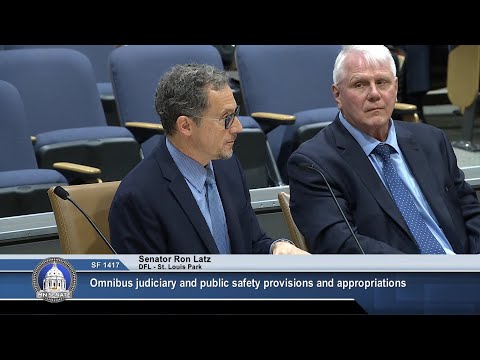
Senate Finance Committee backs omnibus judiciary and public safety budget after debate on staffing, operating adjustments and new tenant contingency
Summary
The Senate Finance Committee recommended passage of Senate File 14‑17, the omnibus judiciary and public safety budget bill, after testimony from agency commissioners warning that proposed operating adjustments fall short and a contentious amendment to create a contingency for a potential federal Section 8 pause was added and approved.
The Senate Finance Committee on April 11 recommended passage of Senate File 14‑17, the omnibus judiciary and public safety budget bill, after a morning of agency testimony and debate over amendments that change program funding and add an emergency eviction‑pause contingency for tenants.
The bill, described by its sponsor as “approximately 3 and a half billion dollars worth of appropriations” for the judicial branch, the Department of Corrections and the Department of Public Safety, carries modest compensation increases and a mix of operating adjustments, fee changes and one‑time appropriations. Committee members voted to adopt a series of technical and policy amendments and to recommend the bill as amended.
Why it matters: witnesses from the Department of Public Safety, the Department of Corrections and the Minnesota Judicial Branch told the committee that the bill’s operating adjustment levels are below what the agencies requested and warned of tangible operational consequences if those shortfalls are not addressed. Separately, senators debated and adopted an emergency contingency amendment intended to provide temporary protections and reimbursement if the federal government sharply curtails Section 8 voucher payments.
Department warnings and agency requests Bob Jacobson, commissioner of the Department of Public Safety, told the committee the department’s operating adjustment is “a highest priority” because it covers employee salaries, rent and IT. Jacobson warned that, with the funding in the bill as drafted, “the BCA alone, this will impact over 2 dozen positions, including criminal investigators, lab staff, and criminal intelligence analysts,” and that the change would lengthen turnaround times for violent‑crime investigations.
Paul Schnell, commissioner of the Department of Corrections, said the bill’s operating adjustment “falls short of the governor’s recommendation” and warned of possible “unavoidable staff layoffs, reduced access to rehabilitative programming, and an increase in idle time.” Schnell said the DOC’s request for fiscal 2026‑27 had been about $110 million but the committee’s level for the agency was roughly $47 million, and he urged committee members to consider operational impacts as the bill moves to conference.
Dawn Torgerson, deputy state court administrator for the Minnesota Judicial Branch, described targeted investments that the branch sees as important, including a 1.5% compensation increase for judges and staff, rent for the Minnesota Judicial Center and an increase in the hourly rate paid to forensic examiners from $136 to $165 per hour. Torgerson said the branch appreciated funding for compliance with federal digital accessibility standards but noted that some ongoing costs remain.
Major budget changes and clarifying details - Operating adjustments: The bill contains operating adjustments for multiple judicial and public‑safety agencies; several line‑items on the bill reflect committee targets that are smaller than the governor’s recommendations. - Staffing impacts: DPS testimony said more than two dozen BCA positions may be affected without fuller operating adjustments. The DOC said underfunding could force layoffs and cut programming that affects facility safety. - Transfers and accounts: The bill creates a Minnesota Victims of Crime account and includes a one‑time transfer of $3,000,000 (fiscal year 2026) to seed that account. - Fees: The bill increases a civil court filing fee from $2.85 to $3.10 (except certain divorces) and raises the civil motion fee from $75 to $100. The filings change is estimated to raise about $2.495 million annually; the motion‑fee change about $765,000 annually. A $30 reallocation to the Minnesota Family Resiliency Partnership from dissolution filing fees was estimated to cost the general fund about $446,000 annually. - Other line items: The bill carries a mix of base adjustments, restorations and one‑time appropriations for items including forensic examiner rate increases, guardian ad litem funding adjustments and operating adjustments for courts and public defense.
Amendments, debate and a tenant‑protection contingency Committee members adopted multiple amendments during the hearing. Key actions and outcomes included: - A14 (deleted assorted policy provisions already passed or expected to be considered separately) — motion prevailed. - A15 (deleted language duplicating a previously passed DOC deficiency bill) — motion prevailed. - A12 (technical/fiscal corrections including a contingency for ignition‑interlock appropriations) — motion prevailed. - A10 (cancellations and reallocations): the amendment canceled some prior appropriations and redirected about $20 million to district court mandated psychological services, the Philando Castile memorial police training fund and the Minnesota Victims of Crime fund — motion prevailed. - A8 (expanded a penalty section to cover infrastructure theft including street lighting and vehicle charging) — motion prevailed. - A17 (contingent tenant‑protection and reimbursement language): Senator Mohammed offered and the committee adopted an amendment to the omnibus bill that would, under a clearly stated contingency, prohibit certain landlord eviction filings and direct the commissioner of management and budget to recapture up to an estimated $66.5 million from housing appropriations to reimburse landlords for lost rental assistance for a 90‑day window. Supporters described the amendment as an emergency backstop in the event the federal government freezes Section 8 payments for an estimated 100,000 Minnesotans; opponents called the change a retroactive reallocation of recently enacted housing funds and raised process concerns. The amendment passed on a voice vote.
Committee disposition After debate and adoption of amendments, the committee voted to recommend Senate File 14‑17 as amended for passage and instructed staff to make technical and conforming changes. Committee roll‑call tallies were not recorded in the transcript; outcomes were announced by voice votes (aye/ no) and recorded as “motion prevails.”
Ending note Committee members and agency witnesses signaled further negotiations ahead in conference committee and on the floor. Agency officials urged additional funding for operating adjustments to avoid service and staffing disruptions, while some senators asked staff and leadership to explore alternate fund sources for the tenant contingency and other reallocations mentioned during debate.