Get Full Government Meeting Transcripts, Videos, & Alerts Forever!
Get email alerts on the Groundwater Recharge topic
No spam. Unsubscribe anytime.
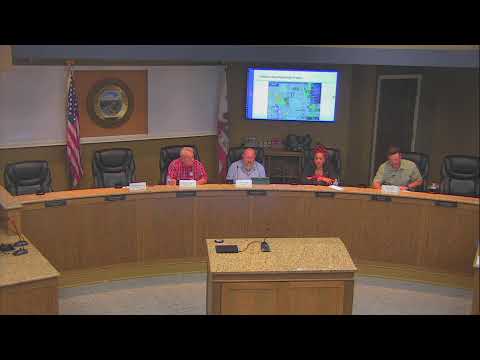
GSA board approves Palermo area recharge project for 60% design
Summary
The Groundwater Sustainability Agency (GSA) board voted to advance the Palermo area groundwater recharge project to 60% design and a cost estimate after a staff presentation and public comment.
The Groundwater Sustainability Agency (GSA) board voted to advance the Palermo area groundwater recharge project to 60% design and a cost estimate after a staff presentation and public comment. A board member moved to approve the recommendation and Duke Sherwood, a Palermo resident and rancher, seconded; the motion passed by voice vote (tally not specified).
GSA staff recommended Palermo after a comparative assessment of potential recharge sites in the subbasin, citing available conveyance, cropped lands suitable for seasonal recharge, about 1,000 acres of “category 1” crops nearby, roughly 40 feet of available aquifer storage in parts of the area, and downstream interest from some landowners in taking surface water instead of groundwater. The staff presentation noted the project’s potential to help balance the subbasin’s water budget as described in the Groundwater Sustainability Plan (GSP).
Consultant (presenter) summarized the technical review, saying the team “came down to Palermo area recharge project as a strong multi benefit project” and recommended moving funds toward a 60% design and a cost estimate. Staff said they had reviewed geology, soils and cropping patterns and flagged next steps that include more detailed site assessments and review of well logs once an area is selected for direct recharge. The presenter also noted alternative sites — the Feather River area and Bangor Creek — were left on the list but scored lower because of limited storage near the river (Feather River) or greater distance requiring long pipelines and pumping (Bangor Creek).
Residents and growers in the room urged the board to consider local conveyance routes and surface channels. Duke Sherwood, a Palermo resident and rancher, suggested investigating Wyman Ravine as a conveyance route and local retention opportunities, saying, “I would just like to suggest that somebody takes a look at that as an option.” Jace Rash, who identified himself as a local landowner, described existing irrigation pumping in the area and quantified local groundwater use: “we have 5 agricultural wells that pump for 6 months straight and they produce 500 to a thousand gallons a minute,” a figure he offered to show the scale of existing groundwater extraction and the potential benefit of delivering surface water.
Staff emphasized constraints the project team flagged: variable subsurface geology that can limit lateral spreading of recharged water in places; the need for retention basins or other controls to avoid creating surface flooding when delivering water into creeks; and the fact that detailed well-log analysis and localized site assessments have not yet been completed. The consultant said those technical tasks would follow site selection and that Palermo’s relative advantage includes shorter gravity-fed conveyance in some reaches and existing conveyance infrastructure that may need only limited expansion.
During the same meeting staff also reported near-term administrative steps: a contracted fee memo from Hansford Economic Consulting is scheduled for presentation in May, Stantec is working on a repeatable tax-roll classification methodology, and staff will return to the board with any contracts required under the agency procurement rule (staff noted a possible change to raise the informal purchase threshold from $5,000 to $25,000 to match county practice). Staff acknowledged some ongoing monitoring and reporting costs are covered by a Sigma grant, but annual reporting costs not covered by that grant may fall to fee payers unless other funding is found.
Next steps identified by staff are to move the Palermo recharge project into design (60%) and prepare a cost estimate, complete the more detailed site-level hydrogeologic and well-log review as designs progress, and coordinate with downstream landowners and South Feather Water and Power on conveyance and water deliveries. The consultant also noted the Wyandotte Creek advisory committee (WAC) had previously expressed consensus support for Palermo as a preferred project.