Get Full Government Meeting Transcripts, Videos, & Alerts Forever!
Get email alerts on the Urban Forestry topic
No spam. Unsubscribe anytime.
Council delays decision on soil-cell requirement for downtown street trees after cost, maintenance questions
Summary
South Salt Lake staff presented draft ordinance language to require soil volume (including modular "soil cells") and updated urban forestry standards for downtown development; council members asked about costs, maintenance responsibility and funding; council moved the item to the May 14 meeting for further refinement.
Sharon Hari, Department of Neighborhoods, asked the South Salt Lake City Council on April 23 to consider ordinance changes that would require larger soil volumes for street trees in new downtown development and to clarify where urban-forestry standards appear in the city code.
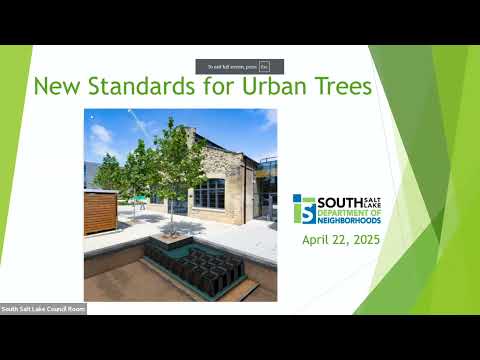
The proposal focuses on a requirement of approximately 1,000 cubic feet of soil per street tree and on allowing developers to meet that requirement either by providing uncovered soil area or by installing subsurface modular "soil cells." Sharon Hari told the council the modular system costs about $30,000 per tree when installed during site construction and that soil cells typically run about $60–$80 per square foot in the downtown context, versus about $1,500 for a conventional tree pit.
The issue attracted detailed questions about long-term maintenance, funding and whether the requirement would apply citywide or only to downtown. Hari said the city currently has limited ongoing urban-forestry operations — "we've been working off a $50,000 grant a year from the U.S. Forest Service" — and that the city would likely need additional staff or contracted maintenance to protect trees over decades. She said the draft ordinance would initially be targeted to the downtown HTRZ area while the city evaluates economic impacts elsewhere.
Why it matters: the changes aim to improve tree survival and create a downtown canopy as the city redevelops. Hari said a completed downtown canopy could provide the equivalent of about 24 acres of shade and that the public and private investments would be long-term infrastructure improvements, not just planting costs.
Key details presented - Cost estimates: Hari said soil-cell installation averages about $30,000 per tree on developments that install the systems as part of site work; conventional tree pits cost roughly $1,500 each. She described soil cells as plastic modular systems assembled on site, then filled with soil and covered. - Funding and incentives: downtown projects using HTRZ (Housing and Transit Revitalization Zone) funds may receive public participation dollars; staff and a city representative noted the HTRZ budget includes streetscape funding and a participation agreement could cover a portion of tree costs on large projects. - Maintenance and responsibility: the current ordinance places maintenance responsibility on the private property owner, and Hari said the city has the authority to prune or remove trees for conflicts. She recommended developing a city urban-forest management plan and said city-led maintenance or a public-improvement/district mechanism could be deployed for downtown. - Scope: staff recommended limiting a mandatory soil-cell requirement to the downtown HTRZ where redevelopment provides a unique opportunity, with the possibility of expanding rules later if the city commits funding and staffing.
Council questions and concerns Council members pressed on affordability impacts for developers, applicability to redevelopment (where pavement already exists), who would replace dead trees and whether developers would opt out. Hari said developers could avoid modular soil cells by dedicating more surface area for soil (reducing buildable area) but that many developers prefer paying for soil cells rather than losing buildable square footage. On replacement and survival, Hari said ordinance language options exist in other cities but added that the city lacks a robust maintenance program today.
Funding and downtown tools City staff and a downtown development representative described the HTRZ framework as a way to subsidize streetscape elements. Spencer (city staff) and Jonathan (city staff) said HTRZ participation and dedicated streetscape funds were already budgeted and that the downtown participation agreement includes discretionary funds that could contribute to street-tree costs.
Next steps and council action After discussion, Councilmember Charlotte moved to postpone further action and return the item to the May 14 regular meeting so staff could refine cost, maintenance and ordinance language; Clarissa (Councilmember Clarissa Williams) seconded. The motion passed on a voice vote.
Ending: staff said they will return with a tighter draft ordinance, clarified cost and maintenance options and proposed code edits for the council's May 14 meeting.