Get Full Government Meeting Transcripts, Videos, & Alerts Forever!
Get email alerts on the Immigration Policy topic
No spam. Unsubscribe anytime.
House panel reports package of bills targeting sanctuary policies and public-benefits eligibility after hours of testimony
Summary
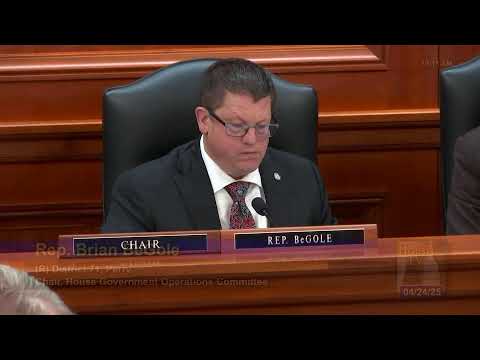
The House Committee on Government Operations reported a package of five bills (HB 4338–4342) by 3-2 votes that would limit local noncooperation with federal immigration enforcement, create enforcement windows and private remedies, and restrict some state-funded benefits for undocumented residents.
The House Committee on Government Operations voted to report five immigration-related bills — House Bills 4338, 4339, 4340, 4341 and 4342 — each by a 3-2 vote, after extended testimony from bill sponsors, law-enforcement representatives, faith groups, immigrant-rights organizations and community members.
Sponsors said the bills would promote uniform cooperation with federal immigration officials, protect public safety and preserve state funds for residents they characterize as legally eligible. Opponents including civil-rights groups, legal-service providers, faith organizations and local officials said the measures would erode local control, chill cooperation with police, duplicate federal law, risk civil-rights violations and harm vulnerable people, including trafficking survivors and U.S. citizens who might be misidentified.
Representative Cabot, who introduced HB 4338, told the committee the bill "ensures that no local government in Michigan can block communication or cooperation with federal immigration officials" and that it "doesn't force local officials to act as immigration agents" but prevents local laws or policies that interfere with federal enforcement. Representative Joe Pavlo (listed in the transcript) highlighted specific enforcement provisions in HB 4339, noting that section 7 would require counties to amend conflicting ordinances within 60 days of the act's effective date and that section 9 would allow a county resident to file a circuit-court action or a complaint with the attorney general beginning 61 days after the effective date.
Representatives who support the bills repeatedly characterized certain local policies as "sanctuary" policies and said withholding discretionary enhancement grants was an appropriate incentive to ensure compliance. Two sponsors argued that denying state-supported housing subsidies or other state-funded benefits to undocumented residents would prioritize limited state resources for citizens and lawful residents; supporters emphasized that the measures were intended not to affect noncitizens lawfully present.
Opponents included the American Civil Liberties Union of Michigan, the Michigan Immigrant Rights Center, the Michigan League for Public Policy and numerous grassroots groups and tribal and faith leaders. Kyle Zawacki, legislative director for the ACLU of Michigan, said the bills "would significantly undermine civil liberties" by pressuring local governments to act as extensions of federal immigration enforcement and by restricting access to vital public services. Eleanor Jordan of the Michigan Immigrant Rights Center said the bills duplicate federal limits on benefits and would "threaten the safety and well-being of Michigan families," including services for trafficking survivors and youth.
The Michigan Catholic Conference testified it had no formal position but urged caution, saying the measures could discourage immigrants from reporting crimes and that the bills' broad language on "cooperation" and "communication" left open questions about what municipalities would be required to do.
Committee members offered several amendments intended to narrow enforcement or clarify interaction with federal law; Representative Fitzgerald proposed limiting enforcement to instances when federal law made certain actions mandatory and proposed language tied to federal 287(g) detainer agreements. Representative McFall offered amendments to preserve eligibility for individuals who have paid into systems or to allow historical or context uses of the term "Gulf of Mexico" in other bills heard earlier. All attempted amendments failed on roll-call votes recorded by the clerk as 3 nays and 2 yays.
On final motions, the vice chair moved to report each bill with recommendation. The clerk recorded 3 ayes and 2 nays on each bill's reported motion; each motion prevailed and the bills were reported to the full House with recommendation.
Key provisions discussed in committee: - HB 4338/4339: Prohibits local laws or policies that limit cooperation or communication with federal immigration officials; contains enforcement timelines (example: 60‑day amendment window) and resident enforcement remedies beginning 61 days after effective date. - HB 4340/4341: Seeks to restrict access to certain state public benefits and housing assistance for undocumented residents (witnesses said the bills largely duplicate existing federal eligibility rules but opponents warned of additional confusion and harm for vulnerable people). - HB 4342: Similar measures to HB 4338/4339 addressing county ordinances and local policies.
The committee did not adopt any amendment to change the bills' enforcement mechanisms or funding impacts. Each bill was reported to the full House with a committee recommendation; committee members did not specify departmental implementation plans or new funding for compliance or enforcement during the hearing.
The measures now proceed to the House calendar and may be scheduled for further committee consideration or floor action. Public witnesses urged lawmakers to consider local control, potential civil-rights impacts and the needs of vulnerable residents when the bills reach subsequent stages.