Get Full Government Meeting Transcripts, Videos, & Alerts Forever!
Get email alerts on the Phoebus Anniversary topic
No spam. Unsubscribe anytime.
City honors Phoebus’s history on 125th anniversary of its name
Summary
Council spotlight recognized Phoebus for 125 years under its current name and celebrated the neighborhood’s deeper history, including early Black residency, Fort Monroe-related events and local preservation efforts by the Phoebus Partnership.
Hampton City Council used a ceremonial spotlight session to honor the 125th anniversary of the name “Phoebus” and to recognize the neighborhood’s longer history and recent preservation work.
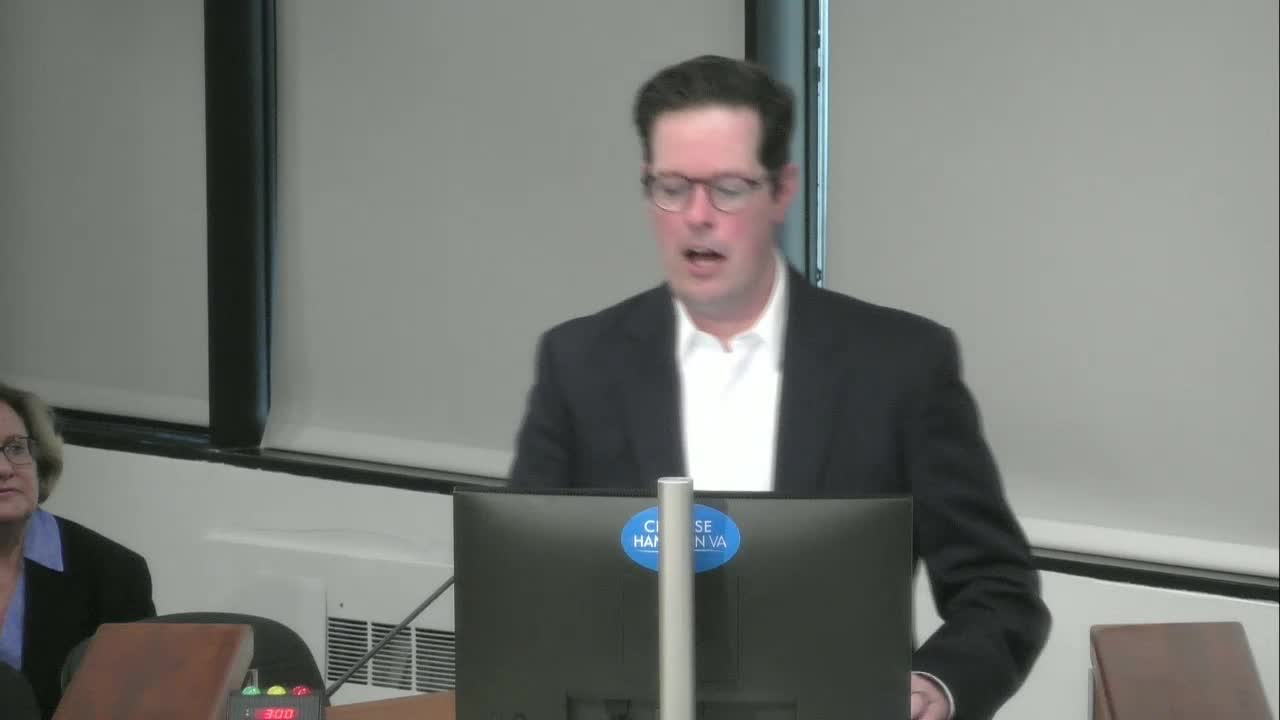
Brian Marchese, the city’s outreach and creative coordinator, gave an historical overview tracing Phoebus’s evolution from Indigenous Kinkitan land through early English settlement and 19th-century developments. "Tonight, we honor a hundred and 25 years since the town of Phoebus took its name," Marchese said, noting a much longer human history in the area.
Marchese described Phoebus’s role during and after the Civil War, including reference to Camp Hamilton near Fort Monroe and the community’s significance as a center where formerly enslaved people established homes and businesses. He said the town was renamed Chesapeake City in 1871 and later took the name Phoebus to honor hotelier Harrison Phoebus, who helped spur local development. Marchese also noted that when Phoebus merged with the city of Hampton in 1952, it brought a distinct local identity that persists today.
The mayor and Marchese invited leaders of the Phoebus Partnership forward to accept a plaque marking the anniversary. Presenters named Robin Carpenter (president), Laura Sanford (vice president), Colleen Walker (treasurer), Joe Griffith (secretary) and Regina (executive director) of the Phoebus Partnership.
Marchese and presenters highlighted Phoebus’s recent designation on the National Register of Historic Places and participation in Virginia Main Street as part of its preservation and revitalization efforts. The remarks described current Phoebus attractions — theaters, restaurants and cultural events — as evidence of the neighborhood’s civic and economic renewal.
The spotlight session was ceremonial; council did not take formal action on preservation policy or funding during the meeting. The session concluded with congratulations to both Langley Speedway and the Phoebus Partnership before adjournment.