Get Full Government Meeting Transcripts, Videos, & Alerts Forever!
Get email alerts on the Agriculture Homestead topic
No spam. Unsubscribe anytime.
Panel considers easing residency rule to help preserve family farms
Summary
Senate File 2772 would relax a proximity rule for the special agricultural homestead, letting owners reside in the same county or an adjacent county rather than within four townships to retain the benefit.
Senate File 2772, introduced April 24, 2025 by Senator Rasmussen, would change the residency requirement for Minnesota’s special agricultural homestead so that owners may qualify if they reside in the county of the agricultural property or an adjacent county rather than within four townships. The Taxes Committee adopted the author’s A1 amendment and laid the bill over.
Sponsor Senator Rasmussen told the committee the change is intended to make it easier to keep family farms in the family when owners need to move for health care or other reasons. “One of the tools that Minnesota tax law has to help family farms both stay in their family and then pass on to the next generation is the special agricultural homestead,” Rasmussen said.
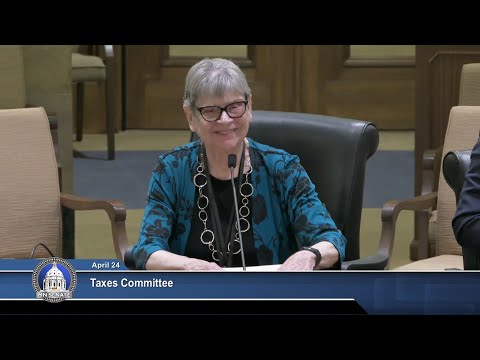
Marilyn (Mary) Mathias, a 77-year-old owner of a century farm near Wheaton in Traverse County, described the current choice forced on older farmers: remain on the farm to keep homestead status or move closer to medical care and lose valuable tax benefits. “The SF 2772 fixes this. It allows me to move near Alexandria, which is closer for medical care, but yet I could keep my homestead status as my son farms the land,” she told the committee.
Her son, Jonathan Mathias, described the practical effect: a township is roughly six miles, so the current four-township rule restricts the owner’s residence to a roughly 24-mile radius; moving farther can trigger tax consequences that affect estate taxes and liquidity for heirs. Jonathan told senators a taxable estate adjustment could force the sale of crops or financing to pay taxes on inheritance.
Hunter Peterson of the Minnesota Farm Bureau said the organization supports the bill as a “common sense reasonable proposal” that helps keep family farms intact while reflecting the realities of rural Minnesota’s limited local services.
The committee adopted the author’s A1 amendment and laid Senate File 2772, as amended, over for further consideration.