Get Full Government Meeting Transcripts, Videos, & Alerts Forever!
Get email alerts on the Residential Tranquility topic
No spam. Unsubscribe anytime.
Sheridan‑Kalorama residents seek permanent limits on unattended megaphones; activists warn of First Amendment risks
Summary
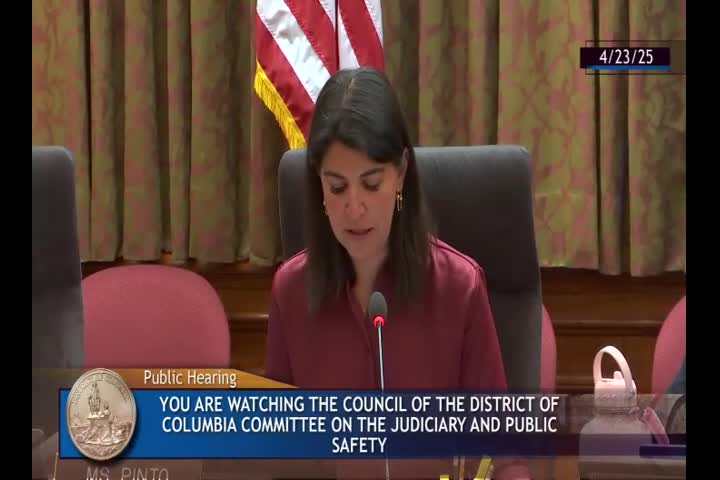
Residents near ambassadorial residences told a D.C. Council committee April 23 that unattended amplified megaphones used in early‑morning and late‑night demonstrations have degraded quality of life, and they asked the council to make emergency restrictions permanent for residentially zoned areas.
Residents of Sheridan‑Kalorama and nearby neighborhoods described prolonged disturbances from unattended amplified sound devices and pressed the council April 23 to adopt permanent limits on the devices in residentially zoned areas.
Marie Drissell, secretary of the Sheridan‑Kalorama Neighborhood Council, described repeated early‑morning demonstrations that used remotely controlled megaphones affixed to trees and lampposts and said video evidence shows demonstrators leaving devices unattended while they drove away. “Unattended amplified equipment should be prohibited at all times,” she said, urging a narrow statutory change focused on residential areas.
Neighbors provided examples of lost sleep, disrupted family routines and a violent incident they said was related to the demonstrations. John Missing, a Sheridan‑Kalorama resident and retired lawyer, argued the measure is content neutral because it regulates the time, place and manner of amplified sound, and he cited court precedent saying the state has a compelling interest in protecting home tranquility.
ANC 2D Chair and Secretary Commissioner Carol Feld told the committee her ANC passed a resolution proposing precise language changes to make the definition of “unattended” more enforceable and to cover residents harmed by noise aimed at adjacent nonresidential properties. Feld said the emergency restriction enacted earlier produced “a drastic improvement to the quality of life” but that some residents still experience noise because of proximity to targeted properties.
Opponents said the bill, as written, risks criminalizing protests and gives law enforcement overly broad discretion. Bill Mefford of the Festival Center and a coalition of 17 organizations argued that existing noise and disorderly‑conduct laws already address many concerns and that the proposed language broadens restrictions on amplified protest activity and could be misused by police. They warned that amplification is often essential to crowd safety and large demonstrations.
Committee members sought to clarify that the bill is intended to be narrowly targeted at unattended amplified devices used to target residences during overnight and early‑morning hours and that it does not ban peaceful protest or mask wearing. Pinto noted that since the emergency restriction was in place there have been no arrests linked to enforcement of the provision.
No vote was taken. Committee members said they will work with ANC2D and other stakeholders on drafting clearer definitions and enforcement language.